[Fifteenth chapter, ‘The Yoga of the Supreme Person’]
Śrī bhagavān uvāca
[The Blessed Lord said]
ūrdhvamūlam adhaḥśākham aśvatthaṃ prāhur avyam chandāṃsi yasya parṇāni yas taṃ veda sa vedavit
[The Lord said They speak of the eternal fig-tree (of samsara) whose tap root is above, whose branches are below, and whose leaves are the Vedas. He who knows it is the knower of the Vedas.]
[Its branches, which are nourished by the gunas and whose shoots are the sense-objects, are spread below and above. Further, (its) roots are stretched below, causing actions in the world of men.]
na rūpam asyeha tathopalabhyate nānto na cādir na ca saṃpratiṣṭhā aśvattham enaṃ suvirūḍhamūlaṃ asaṅgaśastreṇa dṛḍhena chittvā
[The form of this (tree) as such is not perceived here. (It has) no beginninig,middle, or end. One should cut, this well-rooted fig tree firmly with the weapon of detachment.]
[Thereafter, that goal should be sought reaching which they do not return again. (One should pray) I surrender to that primal God from whom the ancient process (of creation) has proceeded.]
nirmānamohā jitasaṅgadoṣā adhyātmanityā vinivṛttakāmāḥ dvandvair vimuktāḥ sukhaduḥkhasaṃjñaiḥ gacchhanty amūḍhāḥ padam avyayaṃ tat [Those who are free from pride and delusion, who have conquered the evil of attachment, who are free from desires, who are free from the pairs of opposites known as pleasure and pain, who are ever committed to the spiritual pursuit, and who are wise attain that impersihable goal.]
na tad bhāsayate sūryo na śaśāṅko na pāvakaḥ yad gatvā na nivartante tad dhāma paramaṃ mama [The sun does not illuminate it; neither the moon nor the fire. It is My supreme abode attaining which they do not return]
*** i put the below as H5 and just para to see how it will display in the app ***
aum tat sat iti srīmad bhagavad gītāsu upanis̩hadtsu brahma vidyāyām yōgasāstrē srī kr̩shnārjuna samvāde purushottama yogō nāma panchadasho dhyāyah:
[Thus, in the Upanishad sung by the Lord, the science of Brahman, the scripture of Yoga, the dialogue between Sri Krishna and Arjuna, ends the fifteenth chapter, entitled ‘The Yoga of the Supreme Person.’]
Om Dhyayamo dhavalavagunathanavatim tejomayim naisthikim snigdhapanga vilokinim bhagavathim mandasmita sri mukhim vatsalyamrta varishinim sumadhuram sankirttanalapinim syamangim madhu sikta sukthim amrtanandatmikamisvarim
We meditate on (Mata Amritanandamayi), who is clad with a white garment, who is effulgent, who is ever established in Truth, whose glances beam with binding love, who is the seat of the six godly qualities, whose radiant smile adorns Her face with auspiciousness, who incessantly showers the nectar of affection, who sings devotional songs most sweetly, whose complexion resembles that of rain clouds, whose words are soaked in honey, who is bliss immortal, and who is the Supreme Goddess Herself.
1. Om pūrṇa brahma svarūpiṇyai namaḥ
…who is the complete manifestation of the Absolute Truth.
2. Om saccidānanda mūrtaye namaḥ
…who is Existence, Knowledge and Bliss embodied.
3. Om ātmā rāmāgragaṇyāyai namaḥ
…who is supreme among those who revel in the inner Self.
4. Om yoga līnāntarātmane namaḥ
…whose Self is merged in yoga (the union of the Self with Brahman).
5. Om antar mukha svabhāvāyai namaḥ …who is inwardly drawn by Her very nature.
6. Om turya tuṅga sthalījjuṣe namaḥ …who dwells in the top most plane of consciousness known as ‘turya’.
7. Om prabhā maṇḍala vīta yai namaḥ …who is totally surrounded by divine light.
8. Om durāsada mahaujase namaḥ …whose greatness is unsurpassable.
9. Om tyakta dig vastu kālādi sarvāvacceda rāśaye namaḥ …who has risen above the limitations of space, matter and time.
10. Om sajātīya vijātīja svīya bheda nirākṛte namaḥ …who is devoid of all kinds of differences.
11. Om vāṇī buddhi vimṛgyāyai namaḥ …whom speech and intellect cannot apprehend.
12. Om śaśvad avyakta vartmane namaḥ
…whose path is eternally undefined.
13. Om nāma rūpādi śūnyāyai namaḥ …who is devoid of name and form.
14. Om śūnya kalpa vibhūtaye namaḥ …to whom the yogic powers are of no importance (like the whole world is unimportant when in dissolution).
15. Om ṣaḍaiśvarya samudrāyai namaḥ …who has the auspicious marks of the six godly qualities (affluence, valor, fame, auspiciousness, knowledge, and dispassion).
16. Om dūrī kṛta ṣaḍ ūrmaye namaḥ …who is devoid of the six modifications of life (birth, existence, growth, change or evolution, degeneration, and destruction).
17. Om nitya prabuddha saṁśuddha nirmuktātma prabhāmuce namaḥ …who is emanating the light of the Self, eternal, conscious, pure, and free.
18. Om kāruṇyākula cittāyai namaḥ …whose heart is full of mercy.
19. Om tyakta yoga suṣuptaye namaḥ …who has given up the yogic sleep.
20. Om kerala kṣmāvatīrṇāyai namaḥ …who has incarnated in the land of Kerala.
21. Om mānuṣa strī vapurbhṛte namaḥ …who has a feminine human body.
22. Om dharmiṣṭha suguṇānanda damayantī svayam bhuve namaḥ …who has incarnated of Her own will as the daughter of the virtuous Sugunananda and Damayanti.
23. Om mātā pitṛ cirācīrṇa puṇya pūra phalātmane namaḥ …who was born to Her parents as a result of their many virtuous deeds over many lives.
24. Om niśśabda jananī garbha nirgamādbhuta karmaṇe namaḥ …who miraculously kept silence when She came out of Her mother’s womb.
25. Om kālī śrī kṛṣṇa saṅkāśa komala śyāmala tviṣe namaḥ …who has the beautiful dark complexion reminiscent of Kali and Krishna.
26. Om cira naṣṭa punar labdha bhārgava kṣetra sampade namaḥ …who is the wealth (treasure) of Kerala (land of Bhargava) lost for a long time and now regained.
27. Om mṛta prāya bhṛgu kṣetra punar uddhita tejase namaḥ …who is the life of Kerala, which was almost dying and is now resurrected.
28. Om sauśīlyādi guṇākṛṣṭajaṅgama sthāvarālaye namaḥ …who by Her noble qualities, like good behavior, attracts the whole creation.
29. Om manuṣya mṛga pakṣyādi sarva saṁsevitāṅghraye namaḥ …whose feet are served by humans, animals, birds, and others.
30. Om naisargika dayā tīrtha snāna klinnāntarātmane namaḥ …whose inner Self is always bathing in the holy river of mercy.
31. Om daridra janatā hasta samarpita nijāndhase namaḥ …who offered Her own food to the poor.
32. Om anya vaktra pra bhuktānna pūrita svīya kukṣaye namaḥ …whose stomach becomes full when others have their meals.
33. Om samprāpta sarva bhūtātma svātma sattānubhūtaye namaḥ …who attained the experience that Her Self is one with the Self of all beings.
34. Om aśikṣita svayam svānta sphurat kṛṣṇa vibhūtaye namaḥ …who knew all about Krishna without being taught.
35. Om acchinna madhurodāra kṛṣṇa līlānusandhaye namaḥ …who continuously contemplated on the sweet sports of Lord Krishna.
36. Om nandātmaja mukhāloka nityotkaṇṭhita cetase namaḥ …whose mind ever craves to see the face of the Son of Nanda (Krishna).
37. Om govinda viprayogādhi dāva dagdhāntarātmane namaḥ …whose mind was burning in the fire of the agony of separation from Govinda.
38. Om viyoga śoka sammūrcchā muhur patita varṣmaṇe namaḥ …who often fell down unconscious, due to the grief of non union with Krishna.
39. Om sārameyādi vihita śuśrūṣā labdha buddhaye namaḥ …who regained consciousness by the nursing given by dogs and other animals.
40. Om prema bhakti balākṛṣṭa prādur bhāvita śārṅgiṇe namaḥ …whose supreme love drew Krishna by force, as it were, to manifest himself before her.
41. Om kṛṣṇa loka mahāhlāda dhvasta śokāntarātmane namaḥ …who was relieved of Her agony by the immense joy of the vision of Krishna.
42. Om kāñcī candraka manjīra vaṁśī śobhi svabhū dṛśe namaḥ …who had the vision of the shining form of Krishna, with golden ornaments such as girdles, anklets, peacock feather, and flute.
43. Om sārvatrika hṛṣīkeśa sānnidhya laharī spṛśe namaḥ …who felt the all pervading presence of Hrisikesa (Krishna).
44. Om susmera tan mukhāloka vismerotphulla dṛṣṭaye namaḥ …whose eyes remained wide open with joy on beholding Krishna’s smiling face.
45. Om tat kānti yamunā sparśa hṛṣṭa romāṅga yaṣṭaye namaḥ …whose hair stood on end when She touched the river of His beauty.
46. Om apratīkṣita samprāptādevī rūpopalabdhaye namaḥ …who had an unexpected vision of the Divine Mother.
47. Om pāṇī padma svapadvīṇā śobhamānāmbikā dṛśe namaḥ …who had the vision of the Divine Mother holding the veena in Her lotus hand.
48. Om devī sadyas tirodhāna tāpa vyathita cetase namaḥ …who became very sorrowful on the Divine Mother’s sudden disappearance.
49. Om dīna rodana nir ghoṣa dīrṇa dikkarṇa vartmane namaḥ …whose sorrowful wailing was rending the ears of the four quarters.
50. Om tyaktānna pāna nidrādi sarva daihika dharmaṇe namaḥ …who gave up all bodily activities like eating, drinking, and sleeping.
51. Om kurarādi samānīta bhakṣya poṣita varṣmaṇe namaḥ …whose body was nourished by the food brought by birds and animals.
52. Om vīṇā niṣyanti saṅgīta lālita śruti nālaye namaḥ …whose ears became filled by the waves of divine melodies emanating from the veena (in the hands of the Divine Mother).
53. Om apāra paramānanda laharī magna cetase namaḥ …whose mind was merged in the intoxicating, limitless, and supreme bliss.
54. Om caṇḍikā bhīkarākāra darśanālabdha śarmaṇe namaḥ …whose mind was filled with peace by the vision of the terrible form of the Divine Mother (Chandika).
55. Om śānta rūpāmṛtajharī pāraṇā nirvṛtātmane namaḥ …who was filled with ecstasy drinking from the ambrosial river of the blissful aspect (of the Divine Mother).
56. Om śāradā smārakāśeṣa svabhāva guṇa sampade namaḥ …whose nature and qualities remind us of Sri Sarada Devi.
57. Om prati bimbita cāndreya śāradobhaya mūrtaye namaḥ …in whom is reflected the dual form of Sri Ramakrishna and Sri Sarada Devi.
58. Om tannāṭakābhinayana nitya raṅgayitātmane namaḥ …in whom we can see the play of these two re-enacted.
59. Om cāndreya śāradā kelī kallolita sudhābdhaye namaḥ …who is the ocean of ambrosia in which the waves of the various plays of Sri Ramakrishna and Sri Sarada Devi arise.
60. Om uttejita bhṛgu kṣetra daiva caitanya raṁhase namaḥ …who has enhanced the divine potentialities of Kerala.
61. Om bhūyaḥ pratyavaruddhārṣa divya saṁskāra rāśaye namaḥ …who has re established the eternal, divine values enunciated by the rishis.
62. Om aprākṛtāt bhūtānanta kalyāṇa guṇa sindhave namaḥ …who is an ocean of divine qualities which are natural, wondrous, and infinite.
63. Om aiśvarya vīrya kīrti śrī jñāna vairāgya veśmaṇe namaḥ …who is the embodiment of rulership, valour, fame, auspiciousness, knowledge, and dispassion; the six characteristics of divine personification.
64. Om upātta bāla gopāla veṣa bhūṣā vibhūtaye namaḥ …who assumed the form and qualities of Bala Gopala (the child Krishna).
65. Om smera snigdha kaṭākṣāyai namaḥ …whose glances are most sweet and loving.
66. Om svairādyuṣita vedaye namaḥ …who leads programmes playfully on the dais.
67. Om piñcha kuṇḍala mañjīra vaṁśikā kiṅkiṇī bhṛte namaḥ …who wore all the ornaments, the peacock feather, the earrings, the anklets, and the flute like Krishna.
68. Om bhakta lokākhilā bhīṣṭa pūraṇa prīṇanecchave namaḥ …who is keen to please the world of devotees by fulfilling all their desires.
69. Om pīṭhārūḍha mahādevī bhāva bhāsvara mūrtaye namaḥ …who in the mood of the Great Divine Mother, seated on the pitham (divine seat), looks divinely resplendent.
70. Om bhūṣanāmbara veṣa śrī dīpya mānāṅga yaṣṭaye namaḥ …whose entire body shines, adorned by ornaments and unique dress like that of the Divine Mother.
71. Om suprasanna mukhāmbhoja varābhayada pāṇaye namaḥ …who has a bright, beaming face, as beautiful as a lotus flower, and who holds her Hand in the posture of blessing.
72. Om kirīṭa raśanākarṇa pūra svarṇa paṭī bhṛte namaḥ …who wears all the various gold ornaments and the crown, like the Divine Mother.
73. Om jihva līḍha mahā rogi bībhatsa vraṇita tvace namaḥ …who licks with Her tongue the festering ulcers of people stricken with terrible diseases.
74. Om tvag roga dhvaṁsa niṣṇāta gaurāṅgāpara mūrtaye namaḥ …who, like Sri Chaitanya, is an adept at removing skin diseases.
75. Om steya hiṁsā surāpānā dyaśeṣādharma vidviṣe namaḥ …who strongly disapproves of bad qualities like stealing, injuring others, intoxicants, etc.
76. Om tyāga vairagya maitryādi sarva sadvāsanā puṣe namaḥ …who encourages the cultivation of good qualities, like renunciation, dispassion, love, etc.
77. Om pādāśrita manorūḍha dussaṁskāra rahomuṣe namaḥ …who steals away all bad tendencies from the hearts of those who have taken refuge in Her Lotus Feet.
78. Om prema bhakti sudhāsikta sādhu citta guhājjuṣe namaḥ …who resides in the cave of the hearts of the pious that are drenched with the nectar of devotion.
79. Om sudhāmaṇi mahā nāmne namaḥ …who has the great name Sudhamani.
80. Om subhāṣita sudhā muce namaḥ …whose speech is as sweet as ambrosia.
81. Om amṛtānanda mayyākhyā janakarṇa puṭa spṛśe namaḥ …whose name, as Amritanandamayi, resounds all over the world.
82. Om dṛpta datta viraktāyai namaḥ …who is indifferent to the offerings by vain and worldly people.
83. Om namrārpita bhubhukṣave namaḥ …who accepts the food offered by devotees with humility.
84. Om utsṛṣṭa bhogi saṅgāyai namaḥ …who is disinclined to be in the company of pleasure seekers.
85. Om yogi saṅga riraṁsave namaḥ …who cherishes the company of yogis.
86. Om abhinandita dānādi śubha karmā bhivṛddhaye namaḥ …who encourages good actions, like charity, etc.
87. Om abhivandita niśśeṣa sthira jaṅgama sṛṣṭaye namaḥ …who is worshipped by the sentient and insentient beings of the world.
88. Om protsāhita brahmavidyā sampradāya pravṛttaye namaḥ …who encourages the learning of Brahmavidya, the science of the Absolute, through the traditional guru-disciple lineage.
89. Om punar āsādita śreṣṭha tapovipina vṛttaye namaḥ …who brought back the great way of living of the sages of the forests.
90. Om bhūyo gurukulā vāsa śikṣaṇotsuka medhase namaḥ …who is keen on re establishing the ‘gurukula’ way of education.
91. Om aneka naiṣṭhika brahmacāri nirmātṛ vedhase namaḥ …who is a mother to many, many life long Brahmacharins.
92. Om śiṣya saṅkrāmita svīya projvalat brahma varcase namaḥ …who has transmitted Her divine brilliance to Her disciples.
93. Om antevāsi janāśeṣa ceṣṭā pātita dṛṣṭaye namaḥ …who watches over all the actions of the disciples.
94. Om mohāndha kāra sañcāri lokā nugrāhi rociṣe namaḥ …who delights in blessing the worlds, moving like a heavenly light, dispelling the darkness.
95. Om tamaḥ kliṣṭa mano vṛṣṭa svaprakāśa śubhāśiṣe namaḥ …who sheds the light of Her blessings on the hearts of those suffering in the darkness of ignorance.
96. Om bhakta śuddhānṭa raṅgastha bhadra dīpa śikhā tviṣe namaḥ …who is the bright flame of the lamp kindled in the pure heart of devotees.
97. Om saprīthi bhukta bhaktaughanyarpita sneha sarpiṣe namaḥ ..who enjoys drinking the ghee offered by the devotees.
98. Om śiṣya varya sabhā madhya dhyāna yoga vidhitsave namaḥ …who likes to sit with the disciples in meditation.
99. Om śaśvalloka hitācāra magna dehendriyāsave namaḥ …whose body and senses are always acting for the good of the world.
100. Om nija puṅya pradānānya pāpādāna cikīrṣave namaḥ …who is happy in exchanging Her own merits with the demerits of others.
101. Om para svaryāpana svīya naraka prāpti lipsave namaḥ …who is happy in exchanging heaven with hell for the relief of others.
102. Om rathotsava calat kanyā kumārī martya mūrtaye namaḥ …who is Kanya Kumari in human form, as on the occasion of the chariot festival.
103. Om vimo hārṇava nirmagna bhṛgu kṣetrojjihīrṣave namaḥ …who is anxious to uplift the land of Kerala, which is immersed in the ocean of ignorance.
104. Om punassantā nita dvaipāyana satkula tantave namaḥ …who has extended the great lineage of Sage Veda Vyasa.
105. Om veda śāstra purāṇetihāsa śāśvata bandhave namaḥ …who is the eternal friend of the vedic knowledge and all other spiritual texts.
106. Om bṛghu kṣetra samun mīlat para daivata tejase namaḥ …who is the divine glory of the awakening land of Kerala.
107. Om devyai namaḥ …who is the Great Divine Mother.
108. Om premāmṛtānandamayyai nityam namo namaḥ …who is full of divine love and immortal bliss, adoration again and again.
Om amṛtēśwaryaí namaḥ
…who is Amṛtēśwari the Goddess of Immortal Bliss.
this is a test sample to see if the foot note will display – style 6
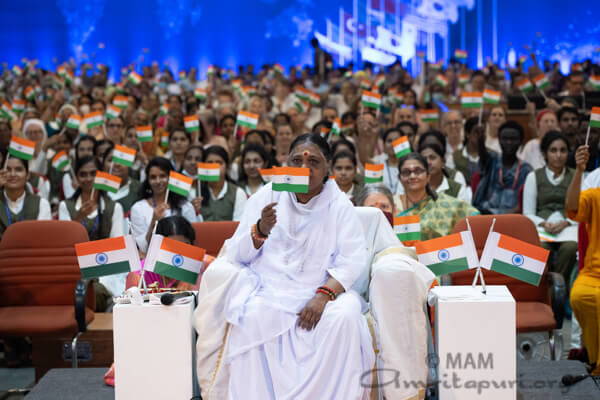
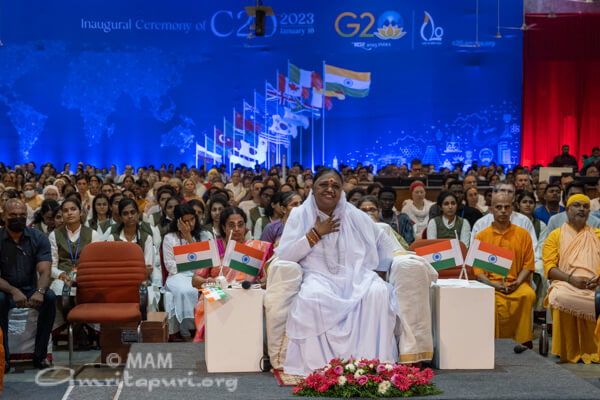
The Govt of India has appointed Amma as the Chair of the country’s Civil 20 (C20), an official engagement group of the Group of 20 (G20). The G20 is the premier intergovernmental forum for the world’s developed and emerging economies to address financial stability on a global basis. The C20 is its platform for civil society organizations (CSOs) to bring forth non-government and non-business voices to the G20 leaders.
India will assume the Presidency of the G20 for one year from December 1, 2022 to November 30, 2023.
The G20’s members consist of 19 countries plus the European Union, and India has been a member since its inception in 1999. Under the auspices of the G20, C20 engages more than 800 civil societies, representatives, and networks of various countries, including organisations from countries who are not G20 members, to ensure that people of all strata of society are heard at the G20 Leaders’ Summit.
Upon accepting her role as Chair of India’s C20 engagement group, Amma expressed she was grateful to the Indian Government for arranging such a high-level representation of the voices of the common people.
In the initial C20 online meeting, Amma said: “Hunger, conflict, extinction of species, and environmental destruction are the most important issues facing the world today. We should put in sincere effort to develop solutions. If scientists of all fields—computer science, mathematics, physics, engineers, etc—would all work together, then we would be able to create more innovative methods of predicting environmental catastrophes, and thereby we would be able to save so many lives. Often, we see a lack of multidisciplinary and integrated effort. This is the need of the hour.
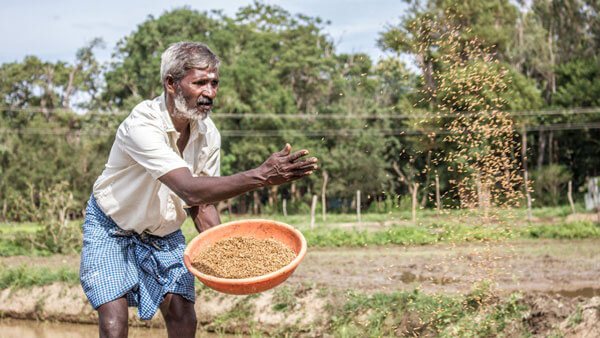
A farmer in Sadivayal, Tamil Nadu sows organic rice, a member of one of our first farmers’ collectives.
“In Sanatana Dharma, Goddess Durga is viewed as a symbol of strength. Goddess Sarasvati is viewed as the symbol of knowledge. And Goddess Lakshmi is viewed as a symbol of wealth. We need all these three factors—strength, wealth, and knowledge. If we improve ourselves, the external world will improve along with us. We need to make self-improvement and mental adjustment a priority.”
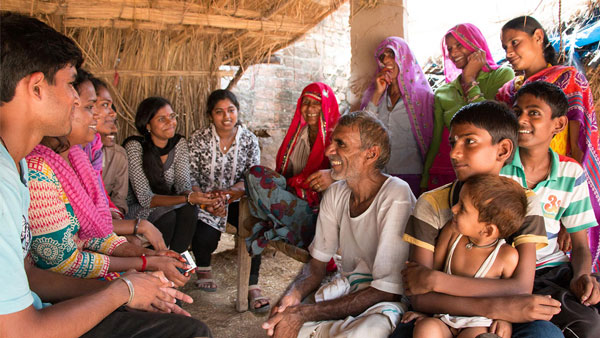
Amma explained that poverty in rural areas is a key issue to address in terms of moving ahead as a society, especially since it is the people there who grow most of our food. Amma has been studying the lives of people in villages all over India and the world for more than 35 years. She has experienced that when we superficially look at villages from on high, we will not find holistic solutions. We need to go to the ground level and understand the issues from their point of view.
“One of the fundamental causes of conflict is hunger. The issue of hunger is very complex. When we go into impoverished villages, we see that often the addictions of men lead to poverty. This poverty in turn prevents women from getting proper nutrition during the vital stages of pregnancy,” said Amma.
“As a result of malnourishment or even of absorbing toxins from contaminated food, their children die at birth. People need to be made aware of the need for nourishing women, especially pregnant women.”
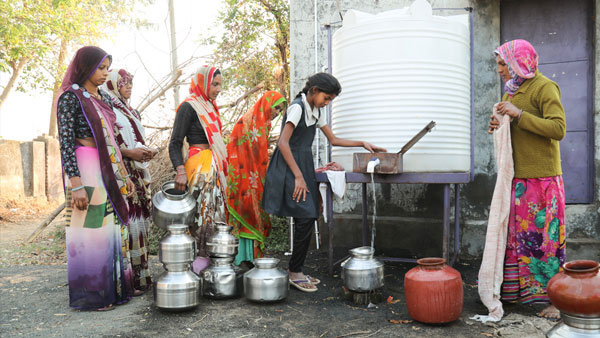
Women in Nani Borvai, Gujarat collect safe drinking water at the Jivamritam filtering system in their village
Amma also spoke about the need to educate villagers about adopting practices outside their traditional ways, as in this day and age many of them are no longer sustainable. Sometimes existing infrastructures even lead to high-risk illnesses. In 2013, the Mata Amritanandamayi MAM (MAM) initiated Amrita SeRVe {news} to help foster self-reliance in 108 impoverished villages throughout India. “In the villages, we started a project called Jivamritam {news}. Through this project, we provide clean drinking water and educate people on the importance of clean water. But there were people in some of the villages who blindly believed that they would only stay healthy by consuming the river water, which was polluted.
“They even believed that if they took the filtered water, they would develop kidney stones and bone diseases. So, in spite of being provided with clean, filtered water they continued to only drink the river water. As such, they continued to have various waterborne diseases,” said Amma.
“Everything needs balance. Just taking antidiabetic medications alone will not lower our blood sugar as long as we continue consuming sugar. So, we need to bring about awareness in the villages, but we also need to go into the villages ourselves and understand all the subtle and individual issues pertaining to each area.”
Amma shared that one of the MAM’s projects has been to build toilets in the villages, alongside teaching villagers how to build their own. In one village when the team returned to check in on progress after a few months, the toilets were being used as puja rooms.
“As far as these villagers were concerned, these newly built toilets were the nicest parts of their homes, and they believed that the nicest part of the home should always belong to God. This is yet another example illustrating how understanding the culture of each area is essential when trying to implement any kind of change,” said Amma.
Students with Live-in-Labs travel to 22 different villages across India to interact with the community and find sustainable solutions for the issues they face.
In 2013, Amma started a project at Amrita Vishwa Vidyapeetham called Live-in-Labs {news}, an experiential learning program where university students from multiple disciplines spend time in rural communities to research, develop, and deploy solutions for sustainable development. Participants from across India and around the world travel to the villages to take part.
The essential component is that the students work with the villagers to gain a better understanding of the challenges they face in their daily lives. In collaboration, Amrita’s teams and the local people build realistic and lasting solutions that are in alignment with the practical needs of the community.
Amma explained: “The students are able to study and understand the ground-level issues faced by the impoverished people. This also helps compassion awaken within the students. Otherwise, students become very self-centred and unaware of those around them. By exposing these students to the suffering of the poor villagers, a sense of responsibility towards the villagers awakens within them.”
Amma also addressed the issue of how depression and mental illness in India are growing with each generation. Though the country is based on the tradition of collective society, identities focused more on individual interests are developing and people are becoming isolated from each other. She said we need to fear the spread of mental illness even more than war and ensure proper counselling facilities for those with mental illness.
“In the olden days, though India had one of the largest populations, there were very few jails or hospitals for mental illness. The facilities in a single state were enough to serve the entire country. In just a short span of time, we have come to require more jails and mental health facilities than many other countries. Our culture has disintegrated into chaos and anarchy. If there are three groups of people, none of the three will communicate. They will not share with each other equally,” Amma said.
To restore a sense of communal ownership and responsibility in villages, the MAM has installed drinking-water systems in schools and in some places, also trained women in maintaining them. In 1998, the MAM also started giving money to women as part of a pension programme called Amrita Nidhi. But the next step for community empowerment came with the launch of sponsoring self-help groups (SHGs) for women.
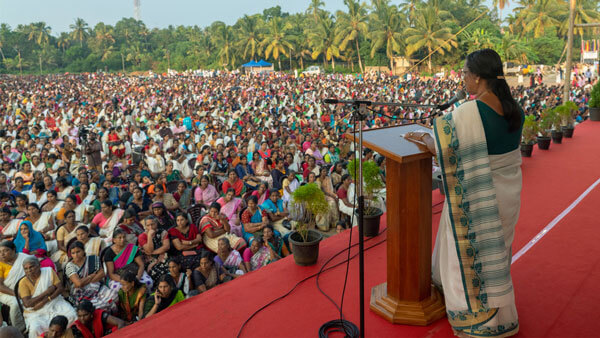
Hundreds of women from across the Kollam district attended the gathering for anual AmritaSREE program
Amma said: “In 2005, we created the AmritaSREE programme {news}. Here, pooled money was given as grant funding from the MAM. Through this, self-financing groups were created to aid in start-up businesses and vocational training. These groups were not only able to make themselves self-reliant, but even made their entire villages so.”
Today, AmritaSREE has helped seed 15,000 SHGs in 21 states across India and 2.5 lakh women have found a means to earn a living, with most of them living in villages and other isolated rural areas. During the pandemic, the MAM also distributed COVID-19 aid packages to AmritaSREE members that consisted of financial assistance, grocery kits, and clothes. The amount of aid provided was ₹85 crore ($11 million).
In concluding her address to India’s C20 team, Amma added: “All the issues raised here are vitally important. However, this should go beyond a mere physical meeting and become a true meeting—a meeting of hearts and minds. This is the only way to awaken ourselves and others.”
Amma bows down to all of you—embodiments of Pure Love and the Supreme Self.
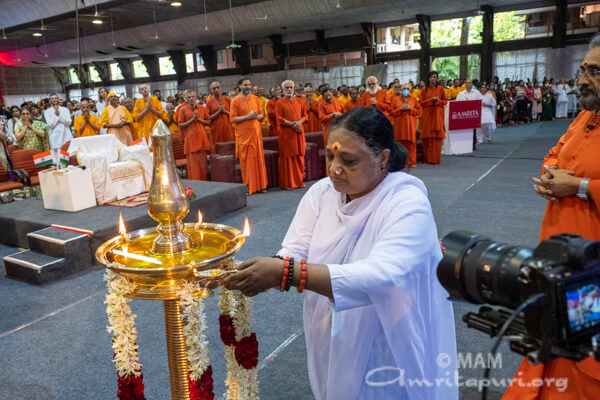
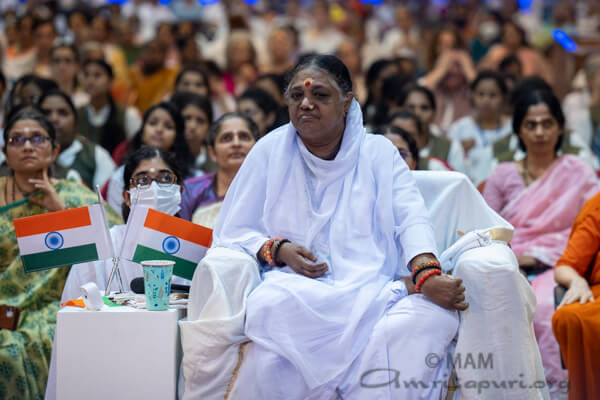
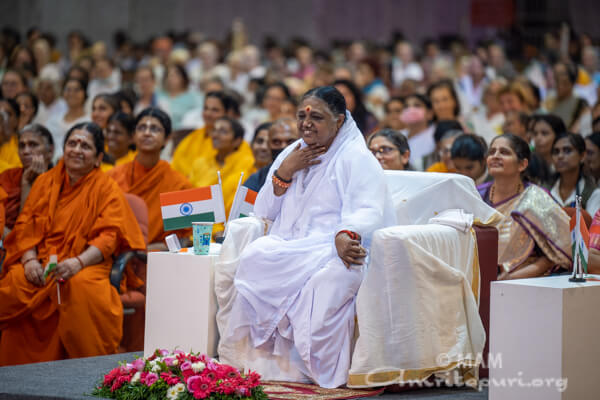
Amma inaugurating C20 inauguration
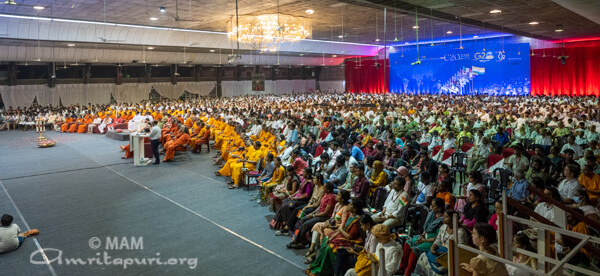
This is an auspicious occasion. We have embarked on a mission to restore the dwindling light of the world. This is a historic year in which India has received the opportunity to assume the presidency of the G20 nations. The Indian Government and Honourable Prime Minister Shri Narendra Modi have given us the tremendous responsibility of successfully facilitating the process of Civil Society 20 (C20), an official engagement group of the G20 Forum. May we be able to do justice to this endeavour. On this occasion, I express my sincere gratitude to the Indian Government and to the Honourable Prime Minister.
VASUDHAIVA KUṬUṀBAKAM—THE WORLD IS ONE FAMILY
The human body, along with everything sentient and insentient in this world, is comprised of five elements—earth, water, fire, air and space. These five elements originate from Nature. This is why humankind and Nature are one. Knowing this truth through direct experience, the ancient ṛṣis of India declared vasudhaiva kuṭuṁbakam—“The world is one family.” So, it is only apt that the theme of India’s G20 presidency is this statement from the Upaniṣads: “One Earth, One Family.”
The main duties of the C20 Forum are resolving issues people face in their fields of work, understanding public opinion, studying the problems people face in different areas, bringing them to the attention of the Indian Government and to the G20 nations, and suggesting solutions.
Humankind is always trying various ways to make life easy and comfortable. It depends on many sources of power. As such, every nation is constantly striving to develop their strength as a nation, in terms of their military and arms, economics, as well as in terms of science and technology. From the perspective of security and progress, all are necessary. However, in our haste to strengthen ourselves in these areas, we have forgotten the force of Nature, which is even more powerful. We have forgotten the great truth that we are a part of this vast universe. Lately, Nature has been giving us a succession of “shock treatments” to remind us of this truth. Even so, we continue to behave as if we have Alzheimer’s—incapable of remembering our lessons.
Humanity should strive to reach the peak of knowledge. Whatever research is required, it should be conducted. However, Amma feels that we should also be ready to investigate the power of spiritual thought and of a lifestyle established in spiritual principles. We should understand the necessity of this from the hints Nature and the universe keep sending us. Only then will we be able to fulfil the principle of vasudhaiva kuṭaṁbakam, at least to some small extent.
NATURE IS GOD’S FACE REVEALED
Today our situation is such that, while we have everything, we really have nothing. One thing is very clear. As humanity grows more and more distant from Nature, our problems only increase. Nature is God’s face revealed.
Humankind has the wrong understanding that Nature is our obedient servant and insentient, and therefore we can treat Her however we please. However, the truth is that Nature is a unified body—a single entity. Just as the parts of a body are indivisibly connected, all aspects of Nature, sentient and insentient, are also interconnected. They are all parts of Nature’s body. This is why development is unsustainable unless it is tied to environmental protection. If we truly want sustainable development, holding conferences and summits, awarding prizes and creating policies and laws are not enough. Humanity’s attitude has to change. If we can change our attitude, we can change our surroundings.
How can we live without earth, water, fire, air and space? These five elements are the basis of our body. So, Nature is both within and without. Living on this earth, we often ignore or reject our fellow beings and Nature; we strive only to fulfil our own selfish desires and greed. At the same time, we pray to God to give us heaven. What a contradiction!
WHAT IS THE STATE OF OUR WORLD?
At this juncture, with almost a quarter of this century completed, what is the state of our world? Close your eyes and place your finger on a map. Now open your eyes and see what continent and nation it landed upon. Wherever it is, find out if that place is peaceful and free from conflict. Is there enough drinking water and food to fulfil the thirst and hunger of everyone there? Is there a roof over every head? And clothes to wear? Is timely healthcare available for everyone? Are the women and children safe? Everyone will know the answer without Amma saying it.
The only difference is that, while the rich cry surrounded by luxury, the poor cry sitting on a broken chair under a leaky roof. Many civil organisations and individuals are actively engaged in finding solutions and doing humanitarian work. But they are only small rain drops falling into the ocean. Yet when they fall in the desert, even such small drops have some benefit. If we understand their place and use them accordingly, they can help bring some joy, peace and health to the world.
IMPARTING THE RIGHT AWARENESS IS ESSENTIAL.
Amma often mentions that we should meet people at their level when interacting with them. We have adopted 108 villages. During their initial visit to one of the villages, the Ashram volunteers learned that all the farmers in the village were contemplating suicide. Why? Their crops had failed repeatedly, and they had lost everything. The seed money they had borrowed was lost, and they could not even pay the interest on the loan. The only way out they could see before them was death. The crops had failed five years in a row.
Our volunteers looked at their process. Where were they buying their fertiliser from? They discovered that the farmers were paying an exorbitant amount for the fertiliser. They were getting cheated. The volunteers intervened and helped them buy it at a fair price. They made the farmers aware of modern agriculture practices. The following year, these farmers had a bountiful crop. They were able to repay the loans that had been pending for five years, and they made enough profit to live on for the year. That year, all those villagers came to see Amma with bright smiles lighting up their faces, to offer Amma some paddy from that crop. We were able to uplift them physically and mentally. So, imparting the right awareness is essential. This is why Amma always says that we should meet people at their level.
THE STUDENTS HAVE BECOME LIKE ROBOTS
Even though public darśan has not been officially declared, people have been coming to see Amma. In the past year, Amma has seen at least 300,000 people. This is because limits were enforced. Normally, Amma sees at least one million people a year.With the end of the pandemic, children returned to schools and universities. There are nearly 150,000 students studying in the Ashram’s educational institutions. So, Amma understands how the pandemic has affected the youth. All over the world, there is a huge difference in students after the pandemic. The children have been sitting indoors only looking at their computer screens and phones. Many parents confide in Amma that this has affected their children’s mental health. They have insomnia. They don’t want to go to school. Many parents burst into tears when they tell Amma this. Many have lost interest in their studies. Many young children learned to order drugs online, have them delivered to their house and use them in the privacy of their own homes. So, the world over, there are many new drug users and addicts now.
Some mothers complain that their children have become addicted to their phones and regularly demand better models. About 40 percent of the parents bring their children with them to Amma, and thus Amma has seen for herself the validity of the parents’ concerns—the changes in the children. Amma has noticed that their minds have become very weak. Their lives have become like tall towers built with stacked bricks without the binding cement; the slightest breeze will topple them. They may have talents, but their mental strength has been lost.
Many children have committed suicide. Many more have suicidal tendencies. Amma has seen the scars where some had slashed their wrists.
Some professors at our university spoke to Amma about the changes in the behaviour of the students after the pandemic. When classes are over, students rush out just to lean against the trees outside, then they lay on the ground, gazing at their phones. Even if their professors come their way or sit near these students, they don’t sit up or even look up from their phones. They show no respect at all. The professors said, “We’re very concerned about this arrogant behaviour of the students. When we were students, this is not how we behaved.”
Another professor said, “As soon as the students come out of class, they plug in their headphones and are either listening to something or talking to someone on the phone. One day, one of their elderly professors accidentally tripped and fell. He cried out for help, but none of the students heard him. They all had their headphones on.” The teacher-student bond has greatly diminished. Looking continuously at their phones, the students have become like robots. They have lost their compassion. Their respect toward their elders and gratitude towards their teachers have greatly reduced from the olden days. They are not able to understand the grief of others.
MORE THAN WAR WE NEED TO FEAR THE STATE OF OUR OWN CHILDREN
If society continues like this, it will soon become like driving vehicles without following a single traffic law. Everyone will knock down the other and all will eventually perish. The sustenance of the creation depends on compassion. If that is lost, everything is lost. We, then, become distant from ourselves as well. When youngsters come under stress, many look to drugs and alcohol. They do not want God to be their “peacemaker.”
Spirituality teaches our mind to assign situations their proper place—such principles are laid out in the Bhagavad-Gītā and other scriptures. But instead of learning this, they condemn God and the scriptures, labelling them blind superstition. Then they drink and take drugs, when the going gets tough. Finally, the entire family is steeped in discord and conflict. Seeing their children’s lifestyle, even the parents lose their will to live.
It seems that much more than war we need to fear the state of our own children. All nations should increase their budget dedicated to strengthening the mental health of their youth—much more so than on defence. We have to teach them how to manage their minds. Someone with a degree in agriculture can easily grow crops. They will know which pests and diseases to watch for and how to treat them if they arise.
THE WORLD IS LIKE A FLOWER
The world is like a flower. If one of the petals becomes pest-ridden, it will affect the rest of the flower. Similarly, if one nation has a problem, every other nation will also be affected. When an individual is affected, so too will be the family. From there, it spreads to society. From society, it spreads to the nation, and from the nation to the world.
People often say, “Oh, that’s their problem, not ours!” This is not true. It is often others’ unresolved problems that become our problem. For example, a fire breaks out on the lowest floor of a 10-storey building. The people on that floor are running helter-skelter, calling out, “Help! Help! Someone, please come! Help us put out the fire!” What if the people on the 10th floor say, “That’s your problem—not ours!” and do not bother to help? What will happen then? The fire will spread upwards. Their unresolved problem will eventually become ours. So, we should never ignore someone’s call for help, saying it is someone else’s problem.
FROM INTERNET TO INNER NET
Anywhere we go in the world, the first question we ask is, “Is there Internet?” “Will I get a Net connection there?” “Will I get the Net connection in that home?” “Will I get a Net connection in that hotel?” If we don’t get it, we will be like a fish out of water, even losing sleep. Spirituality is, in fact, the Inner Net. If that connection is strong, no external situation will be able to disturb us or stress us out. It will allow us to adjust to situations while at the same time being compassionate. It will give us the capacity to forgive, forget, forbear and give back. We will be able to do this with joy. This is what we call spirituality.
A study was once conducted on the general attitude of the world’s population. Only one question was asked to the citizens of each country: “Kindly state your honest opinion about the strategies to overcome food shortage implemented in other countries around the world.”
People in some countries responded, “Food? What is that?” Some people in some other countries responded, “Honest? What is that?” Some people did not even know the meaning of “opinion.” Some others asked, “What does the word “kindly” mean?” Some people had no idea what “other countries” meant. This is the state of our world. To achieve success in this world, everyone should become aware of everyone else.
DIVERSITY IS AN OPPURTUNITY
It is not possible to achieve this externally in the physical realm. We cannot remove diversity from the world. But diversity is not a drawback or limitation. It is an important opportunity. It is an opportunity to see the oneness, or the truth in diversity.
WHAT WE GIVE IS WHAT COMES BACK TO US
What we give is what comes back to us.In my childhood, my mother taught me that the river was an embodiment of Devi [the Goddess] and to never urinate or spit in it when I took my daily bath. Every time I got into the river, the cold water would make me feel the urge to go, but I could turn it off like a switch, remembering my mother’s words. I could control myself. The gain was mine, because I could bathe in clean and pure water, even the next time I went to take a bath. Because I was taught the value that one should not urinate in the river, I could control myself. If we receive values at a young age, we will be able to control lower impulses, negative thoughts and emotions. At present, no one can control their emotions. People are increasingly becoming like rockets that have escaped Earth’s gravitational field, not knowing where they are heading. Therefore, we have to instil the proper values in our children.
THE PROPER MEANING OF HEALTHCARE
Amma understands that integrated healthcare, gender equality and science and technology are part of the C20 process. Today, most people perceive health only as related to the physical body. However, human existence is not merely at the level of the body. Mental, intellectual and emotional health are also important. Over and above, we must acknowledge the strength of the all-pervasive spirit, the ātma-śakti, that imbues everything with consciousness. When one gives all these factors equal importance in one’s life, the meaning of healthcare becomes complete.
Modern medicine and treatment systems are certainly important and have their place. However, real healthcare is not just seeking medical treatment when sick. In reality, Nature is our closest friend because we ourselves are Nature. Therefore, moving in harmony with Nature is most important for holistic health.
WORSHIP OF TREES IS NOT PRIMITIVE, BUT PRACTICAL
Our university conducted research on the soil where people dumped a lot of waste. The soil was found to be highly toxic. Many saplings were then planted there, and after three years, we retested the soil. The soil tested clean and toxin-free. This proves how much soil toxicity is absorbed, processed and cleaned by tree roots. Moreover, trees cleanse the atmosphere and give us clean air to breathe.
Our ancestors used to worship trees as divine beings. In my childhood, I saw people pray for forgiveness beneath trees before cutting them. This was their way of showing gratitude for what they had been provided. Although some people may label such devotion as “primitive,” Amma feels this is practical. We may have to backtrack a little and revisit that time again. Without connecting to Nature and without Her blessings, holistic health is impossible.
CHEMICALS AND PESTISIDES
About 60 years ago, during my childhood in the village, cow dung would be applied to scrapes and wounds, and they would heal. If we were to do that today, the wound will definitely become infected. So, cow dung, which once had healing properties, has today become poisonous. Why? Because before, cows were fed natural feed. The paddy crop was never sprayed with chemicals. But today, almost all crops are sprayed with poisonous chemicals. Cows eat this. The cattle feed contains chemicals and bone powder. The milk does not have the same quality. It may appease our hunger, but our immunity is also compromised. Through this we may get larger quantities of milk, but many diseases also arise.
If science has allowed man to spray 5% pesticides and chemicals on the crops, many spray around 25% to increase their profits. Our bodies and minds are getting polluted. Amma is not saying to put a complete stop to their use. More stringent regulations are required.
EMPOWERING CHILDREN AND WOMEN
Regarding gender equality, many nations still treat women as inferior. Science and technology have developed, and the world has made tremendous progress. Humankind is becoming more and more sophisticated. Despite this, somewhere deep within, there still is a great reluctance and mental block in acknowledging women’s equality. Among adolescent girls between the ages of 15 and 19 worldwide, one in four is denied education and employment. In the case of boys, this statistic is one in 10.
Another important topic is empowering children and women from marginalised groups. We should consider it a yajña [sacred undertaking] to hold their hand and help them escape their vulnerability. We should not let their hidden abilities go to waste, benefiting neither them, nor their societies.
The Ashram has been supporting villages in 25 states for many years now. At first, Amma had instructed that 108 villages be adopted. Then, when we visited the villages and taught skills to the women, some of the village menfolk would say, “We don’t want to live by sending our women to work. If they begin to work, they’ll become arrogant. They will not obey us.” This is the way many men think. They have been conditioned to think like this from childhood, so Amma is not blaming them.
Thus, we taught them skills they could do from their own homes. The women began to do jobs with the training they received and earn money. In some places, however, the men were too rigid. There are thousands of incidents like this that we have learned from. When women are suppressed, the world loses the productive contribution of 50 percent of its population.
WOMEN SHOULD TRY AND DEVELOP THEIR HEART MUSCLES
As women rise and move ahead, men should make way—even prepare the way—for them. Men should stop being a one-way street, and, instead, try to become a broad highway. Instead of trying to develop their muscle power like men, women should try and develop their heart muscles. That is what Amma means by the Malayalam word tantēḍi—being courageous. They must be ready to accept what comes and move forward, without losing their self-confidence. We should create circumstances for them to succeed. Otherwise, it will be a huge loss for society.
Amma has met millions of people. Even among the girls studying in our college, parents pressure them to get married once they complete their undergraduate degrees. Few are allowed to pursue their PhD. The parents pull them back, saying that by the time they complete their PhD, they will be past marriageable age and it will be difficult to find them a husband. Students come to Amma and say, “Amma, I want to pursue my PhD, but my parents are asking me to look for a job.” So, Amma introduced the system of providing students scholarships, wherein they are provided with the same remuneration they would receive from a job. The students were talented. Immediately Amma provided 100 PhD scholarships to encourage girls to pursue PhDs. Many of these girls are now PhD scholars; they have honed their talents well and have publications in prestigious journals. Many have completed their PhDs and are married too.
If we live in fear that our girls will not be able to get married, can anything be accomplished? If we create the right circumstances, they can definitely bring out their talents and make them useful for society.
GLOBAL WARMING OR CLIMATE CHANGE? CHANGE OUR INTERNAL CLIMATE
One thing is clear: If we want a lasting solution to the atrocities humankind is facing today and will have to face in the future, we should be willing to change our internal climate. What is happening in the external environment—be it global warming or climate change—is but a reflection of the harsh climate in our minds. Today people devote most of their time and energy to labelling everything they see with their name and address—be it land, Nature or God. We try to claim and establish our authority over everything, with the attitude of “I” and “mine.” If this attitude grows, we will become our own worst enemy.
MIND IS HIS ENEMY, AS WELL AS HIS FRIEND
Amma recalls a story in this regard: Once, a dog felt a deep desire to travel and tour the world. He set out on his journey. After many days of travelling, he finally returned home. His dog friends came to visit him, enquiring about his trip. “How was the journey?” they asked, “Did you face any trouble on the way?”
The traveller dog replied, “No, I did not encounter any trouble from others. Everyone let me go on my way. The only ones who troubled me were our own species—other dogs. Everywhere I went, they pounced on me, barking and biting. They chased me mercilessly and gave me no peace whatsoever!”
Humanity’s state today is like that of this dog. Wherever people are in the world, they are their own worst enemy. To be more precise, man’s own mind is his enemy, as well as his friend. However, since the source of our thoughts and actions is our own mind, if we sincerely want to implement corrections to it, spiritual values should be included as part of the curriculum in our educational institutions.
ASHRAM IS CULTURE LABORATARY
In our Ashram, there are about 200 children from all parts of the world. Some stay here for a few months of the year. They attend classes for Bhagavad-Gītā and scriptures. When they listen to spiritual teachings, they are able to share the same toys with other children, though they used to throw a tantrum if another child even touched their toys. For a friend’s birthday, they even give these toys as gifts. In their talks, they speak of how they gave away a favourite toy to another child for her birthday, and that they felt happier in giving, rather than in getting the toys for themselves. Having listened to spiritual teachings, these children felt more joy in sharing than when getting something for themselves. This means that, when spiritual teachings are properly assimilated, they expand our heart and make us more aware.
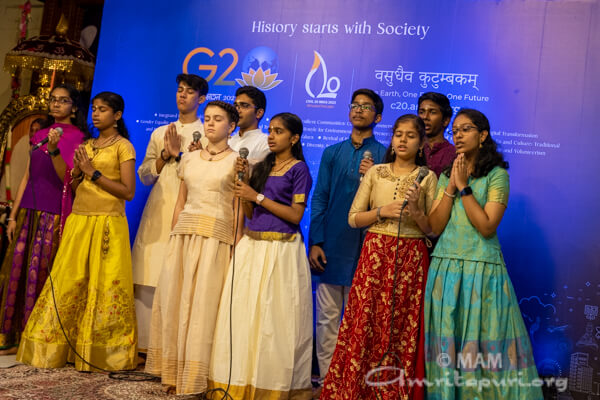
Ashram children leading the prayers during the inauguration of C20
The Sanskrit word saṁskāra means “culture” or “that which is refined over time.” In a laboratory, a “culture” refers to a small specimen of bacteria that is given a favourable environment to grow for a diagnosis. It is done to identify the disease and provide proper treatment. In a similar manner, when a little of the Ashram culture was instilled in the children, and given a conducive atmosphere to grow in, it flourished the same in all of them. The children also started to practise what they had learned. Even the little ones can recognise right from wrong.
Some use their discernment and think, “Oh, is that toy a want or a need? No, I don’t need it. I would prefer to give the money to a poor child.” They can do this at such a tender age. Even before learning the alphabet, they have started to practise charity. Seeing this, Amma believes it’s possible to instil values of charity and dharma [understanding and implementation of what is right to do] in children at a young age. They have so much love and closeness between themselves. When one of them is sick, they all call and ask them how they are. Amma believes that we can certainly bring about such positive changes if we train children from a young age.
WE CAN MAKE THIS EARTH A HEAVEN
If we focus on fulfilling our needs rather than our desires, we can make this Earth a heaven. Think of a beautiful, flowering garden. Many children are in the garden, running, laughing and joyfully playing. Butterflies flutter among the flowers, happily drinking nectar. Amma wishes that the world was like this beautiful and peaceful garden. By fluttering butterflies, Amma means all people, all over the world, living joyfully. Everyone would get their rightful share. People do not have to give away everything they own to achieve this; they only have to give a little of their share. If we do this, we will not become an isolated island, alienated from the world. We will become a link in the chain of life.
For the growth and progress of the individual, family and society, proper culture has to be developed. The environment for this has to be developed within our mind. The circumstances for this to grow should be provided in our homes and our educational institutions.
Vice Chairman Swami Amritaswarupananda is giving vote of thanks
FEW IMPORTANT AND RELEVANT SUGGESTIONS
Amma would like to suggest some things I think are particularly important and relevant at this time:
1. From kindergarten to grade 12, as well as in higher education, a course that teaches compassion and selflessness should be created. A mandatory textbook including all aspects of the greatness of selflessness and compassion should be introduced.
2. Every child should plant a tree on their birthday and be taught how to care for it with love and compassion. They should be encouraged to make paper seed-balls with a hundred seeds and a little manure that can be tossed into the woods. No water or fertiliser is needed for the seeds to grow in the woods. The fallen leaves themselves will enrich the soil and nourish the plants. If even one of the seeds sprouts and grows, we can restore a small part of Nature. It will be good if everyone can resolve to do this.
3. Projects should be developed where villages are adopted with the support of multinational corporations and businesses. Then schools, colleges, hospitals and small-scale industries should be established in them.
4. Right from childhood, boys should be taught to treat women and girls with respect. Teach children to idolise the quality of love. From preschool, make children understand that just as God is love, love is God.
5. Before completing their courses, students should be taken to visit a poor village. When they stay for a few days in such a village, they will face the daily problems the ordinary people encounter, and with this experience, they can design course projects to uplift them. Before they enter the world of bitter selfishness and competition, this experience will sow a few seeds of compassion and selflessness in their hearts. It will teach them to bow down in humility before the infinite power of Nature. The care that Nature provides is above and beyond what our birth mother or father can provide. For this great gift, we must express our gratitude.
6. Leaders of all religions should teach their followers to be inclusive and to never discriminate against anyone based on religion.
7. It should become mandatory for all educational institutions to train their students, from lowest to the highest, to use technology with discernment and give them opportunities to put it into practice.
8. All schools and colleges should have counselling services available. Many students have been suffering from depression since the start of the Corona pandemic. I have seen many students being able to come out of it without medication, because they received counselling at the right time. Those who did not opt for counselling had to take medication. We need to be alert and aware of the mental health issues in youngsters, and such services will be of great help.
ONE MIND AND ONE GOAL
Let us all proceed, with one mind and one goal, to work selflessly for the world’s welfare. May our acts become a noble ideal for those who will come after us. May the tree of our life be firmly rooted in the soil of love. May our good actions be its leaves. May our kind words be its flowers. May peace be its fruits. May this world grow and prosper as one family, united in love. May the ethos of vasudhaiva kuṭuṁbakam—“The world is one family”—awaken, be put into practise and bear fruit in everyone. May we realise a world where there is endless peace and harmony. May divine grace bless us all.
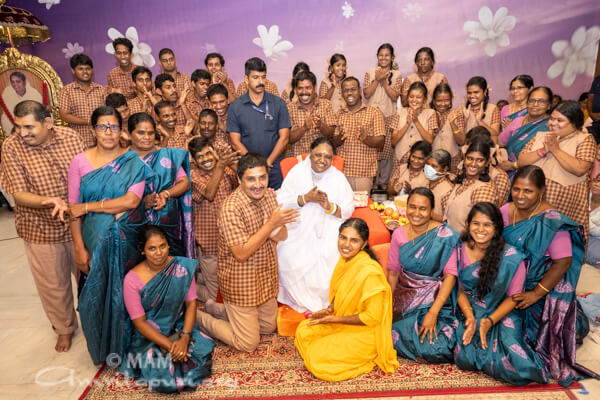
In a touching and joyfilled event, 30 students from the Amrita Institure for Differently Abled (AIDA), a school for the mentally challenged in Kochi, (managed by MAM) accompanied by their teachers, had the unique opportunity to meet Amma at Amritapuri. The air was filled with innocence, laughter, and pure hearts as each student had a sweet and personal interaction with Amma.
During the heartfelt interactions, one of the students expressed a concern many of us share—will our prayers be answered? Amma, with her usual warmth and wisdom, reassured, “All innocent prayers will be answered by God.”
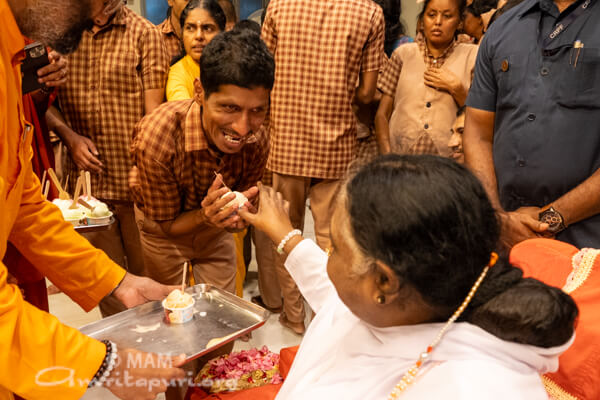
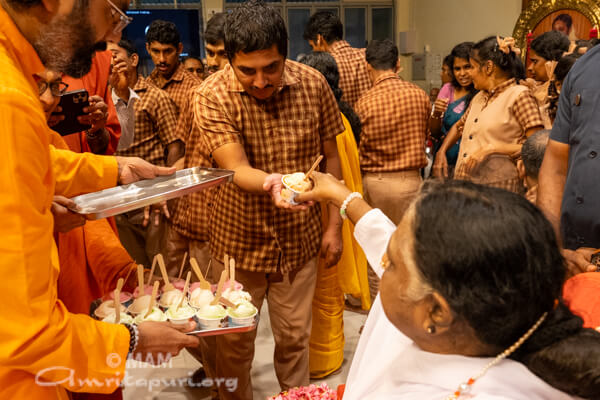
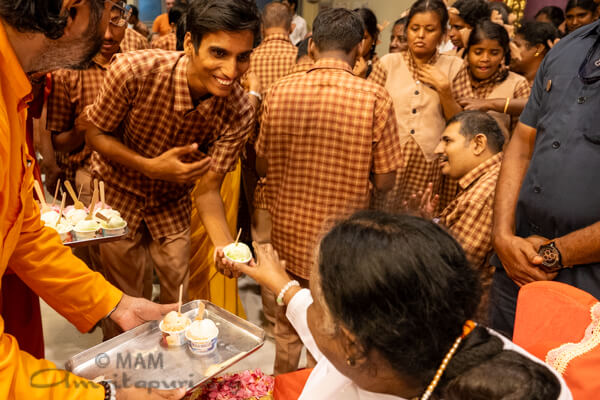
“I have a desire to have icecream” said the boy.
In a beautiful demonstration of her words, as soon as the group finished their time with Amma, she promptly ordered the brahmacharinis to bring ice cream for everyone, students and teachers alike, fulfilling a simple desire expressed by one of the students.
The visit was marked by the students showcasing their talents with bhajans, mono acts, and dancing, creating an atmosphere of pure joy. Amma, fully immersed in their performances, cherished every little movement and word, reflecting the genuine connection she shares with all beings.
Notably, the oldest child in the class, a 52-year-old boy, stood as a testament to the timeless nature of innocence and the enduring spirit of learning.
Beyond the talents displayed, what stood out most was the evident love and care the students had for each other. Their bond was a testament to the nurturing environment provided by their school and teachers. This heartwarming display prompts reflection on the true essence of education—is it not meant to instill love, compassion, and a sense of community?
Amma, with her unwavering love and presence, provided the students with a rare opportunity to capture a moment forever—a group photo with her. This precious memento will undoubtedly be a source of inspiration and joy for the students, that they experienced during their special day with Amma.
Amma’s embrace extended beyond words and actions, embodying the essence of true education—one that fosters a sense of belonging, understanding, and care for one another. The day at Amritapuri served as a beautiful reminder that in the simplest gestures and interactions, the profound lessons of love and humanity unfold.
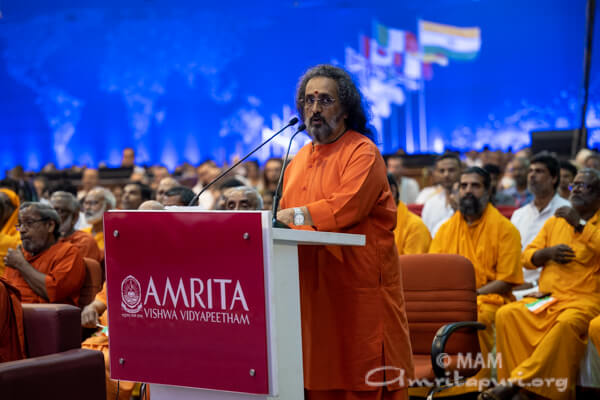
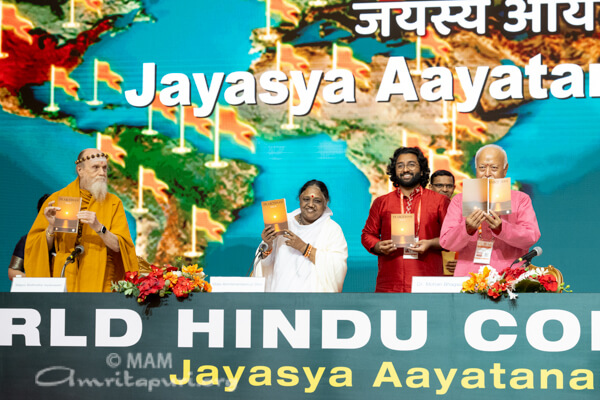
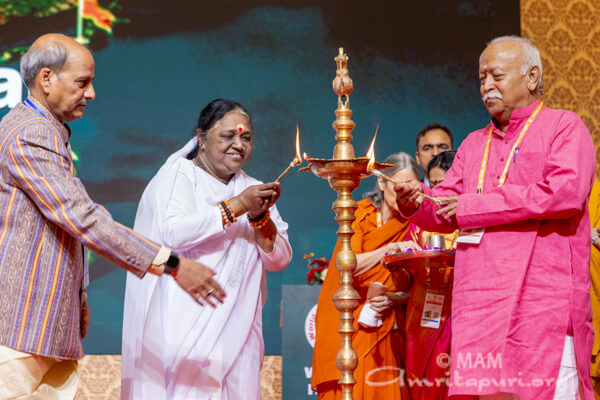
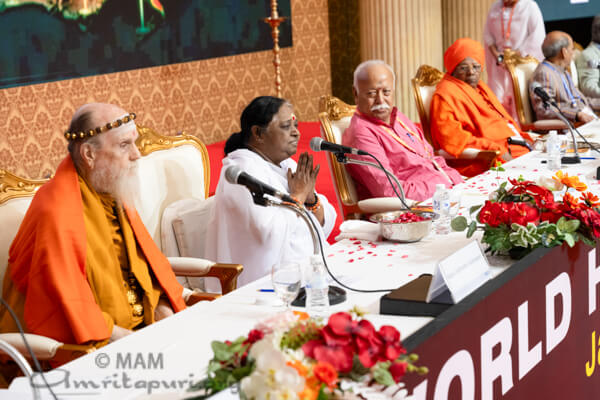
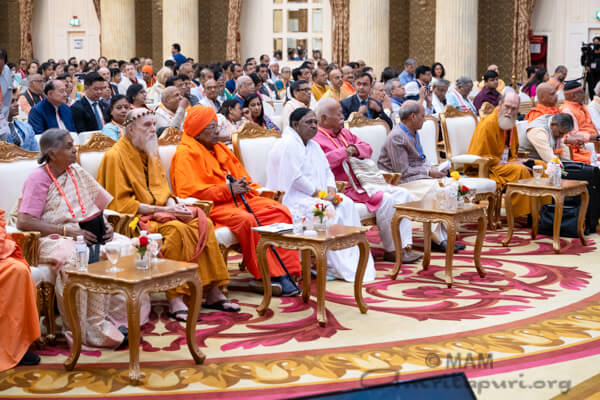
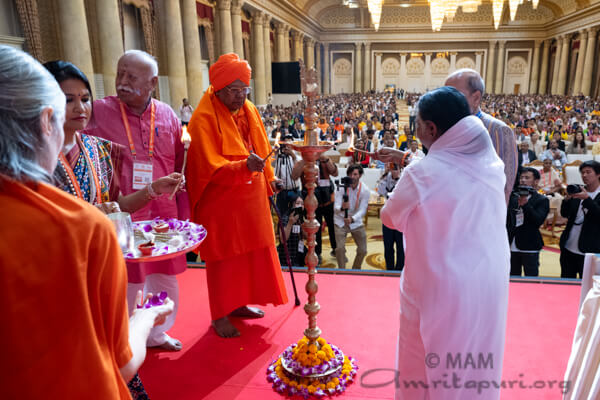
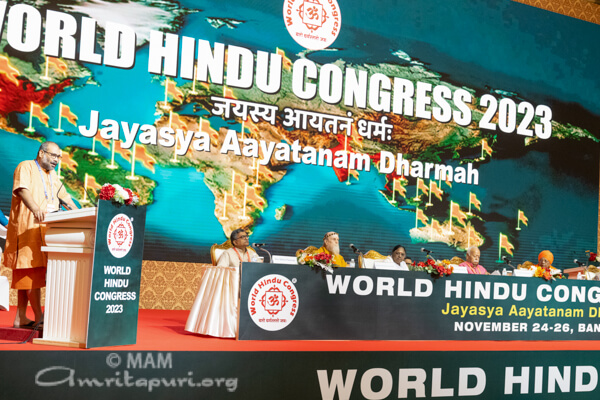
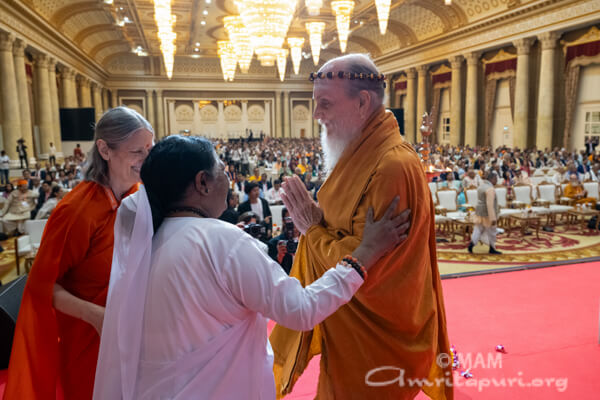
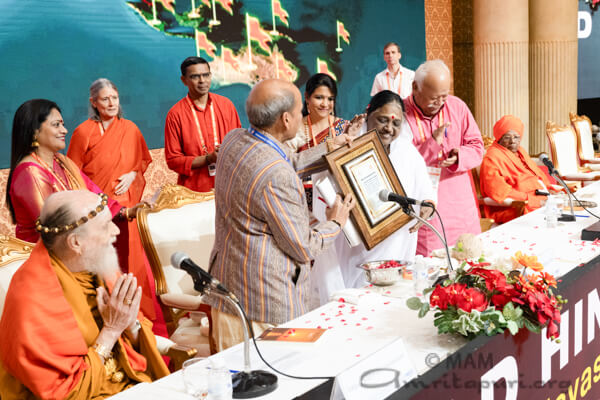
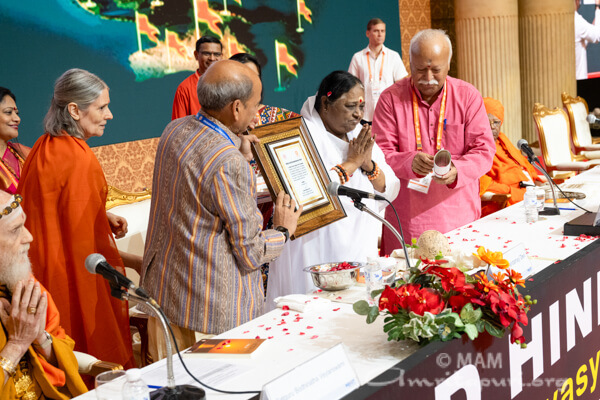
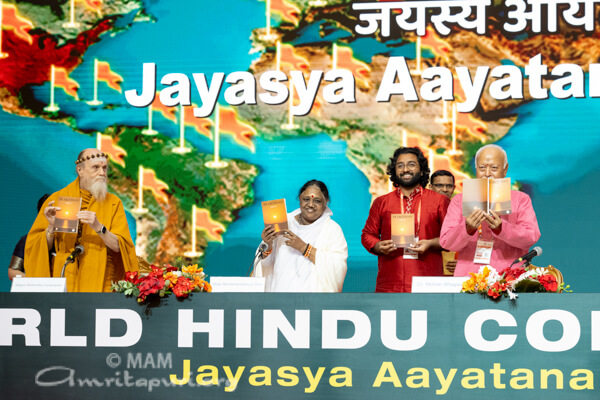
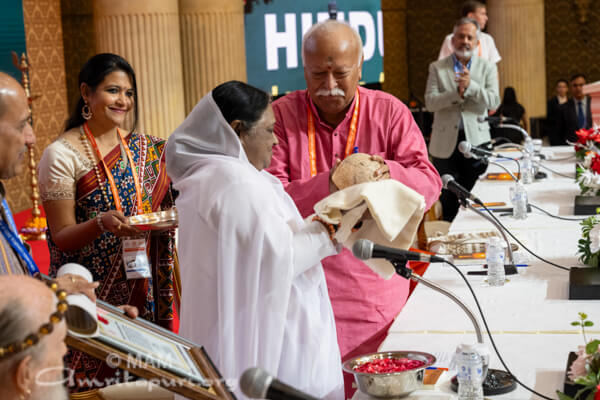
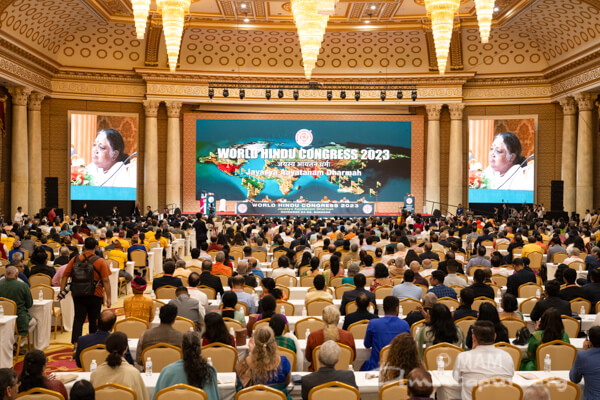
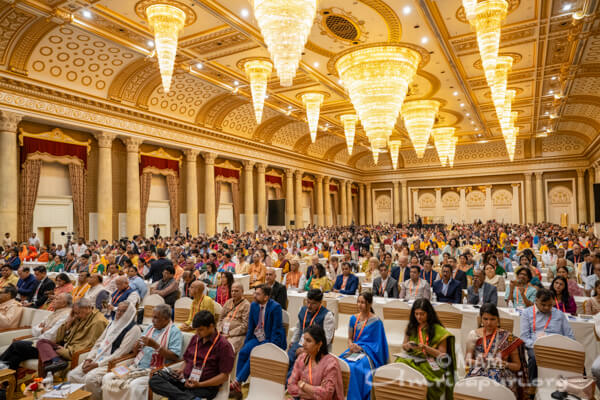
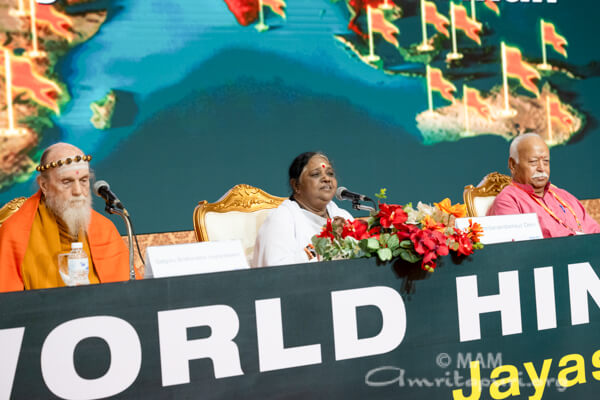
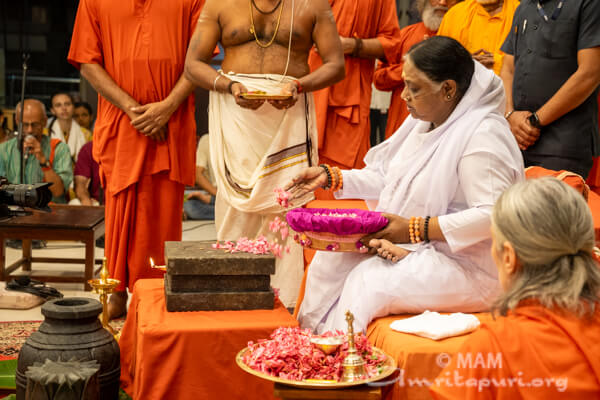
Amma graced the World Hindu Congress with her presence at the Chhatrapati Shivaji Maharaj Hall (Royal Jubilee Ballroom) in Bangkok, Thailand. The quadrennial event, themed “जयस्य आयतनं धर्मः Jayasya Aayatnam Dharmah” (Dharma – The Abode of Victory), witnessed Amma joining hands with Swami Purnatmanda Maraj, Satguru Bodhinatha Veylanwswami, DR Mohan Bhagavat, Susheel Saraff and other esteemed dignitaries to symbolically inaugurate the proceedings by lighting the lamp.
Amma inaugurating the plenary session with Dr Mohan Bhagavat
This three-day congress brings together over 2400 delegates from more than 60 countries, engaging in seven parallel conferences focusing on diverse aspects such as economy, education and academia, media, politics, organizations, unique leadership, and the contributions of Hindu women and youth.
Amma, in her brief address, spoke about the profound spiritual heritage of Bharat. “A very powerful vibration pervades every particle of sand, every atom, and the very atmosphere of our country, Bharat. It is the vibration of Vedic chants and spiritual austerity performed by countless ancient Rishis. It is the pulsation of spiritual power. This is the invaluable speciality of Sanatana Dharma,” she expressed.
“May my children have the strength to overcome all the obstacles that they have to face in their way towards establishing Dharma. May the obstacles of the outer world never deter you. May spiritual knowledge and power help you at all times and in all circumstances” she continued.
Amma emphasized the universal essence of Dharma, stating, “Everything is governed by Dharma. Bharat is the land that has taught the world the ultimate truth. That God is not a remote, abstract concept, but truly exists within us as our very own breath—our hearing, sight, touch, taste, thoughts, and emotions. Our very pulse and circulation.”
Amma addressing the plenary session
In her heartfelt prayer, Amma invoked spiritual wisdom. “May that abundant source of spiritual wisdom, which has not yet run dry, emerge and surge powerfully like the River Ganga. May it once again spread across the land and purify the Earth. May we all take a pledge to make it so. This is Amma’s prayer to the Paramatman.”
“May the tree of our lives be rooted in the soil of love. May good deeds be the leaves and kind words be the fruits. May the world flourish as one family, united in love. May we thus be able to create a world in which peace and contentment prevail,” shared Amma.
On the conclding day, Amma is scheduled to address and bless the conference further on the 26th at 10:00 AM, offering her wisdom and guidance to the attendees. Stay tuned..click here
Amma and the dignitariesAmma lighting the lamp, inaugurating the sessionAmma with Bodhinatha Veylanwswami of Hinduism TodayAmma is being honoured by the World Hindu CongressDr Mohan Bhagavat is offering his tributes to AmmaOver 2400 delegates are attending the conferenceAmma addressing the gathering: “Everything is governed by Dharma”
In a touching display of devotion and community support, Amma graced a simple ceremony at the ashram to bestow blessings on the Shadadhara Shakti Peetham for the Pratishta of Lord Vishnu at Kuzhithura Sri Krishna Temple.
Local devotees, passionately involved in the temple’s renovation, received Amma’s guidance and support during a simple yet spiritually significant ceremony.
Following her customary traditions, Amma conducted a simple puja to sanctify the renovation effort, extending her divine blessings to the entire community initiative.
The village ladies, adorned in traditional dresses, added a touch of cultural richness to the occasion. Holding ‘talappoli’ lamps in their plates, they joined in the procession to carry the sacred Shakti Peetham to the temple.
The atmosphere resonated with the melodic chanting of ‘Hare Rama’ as the villagers, carried the Shakti Peetham to its destination.
What adds a poignant layer to this scene is the villagers’ profound respect and admiration for Amma, who shares the same birthplace.
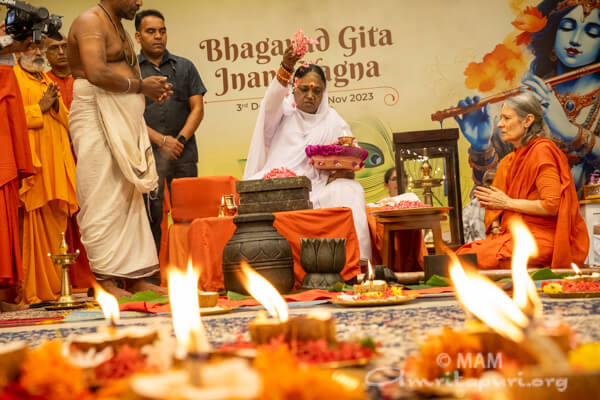
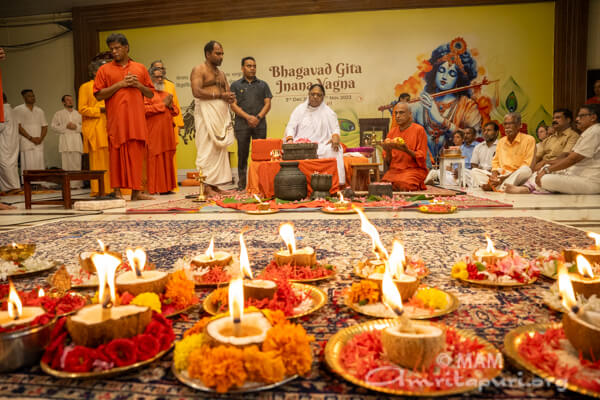
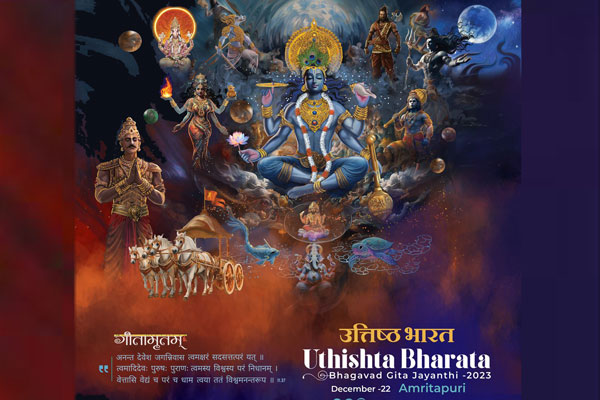
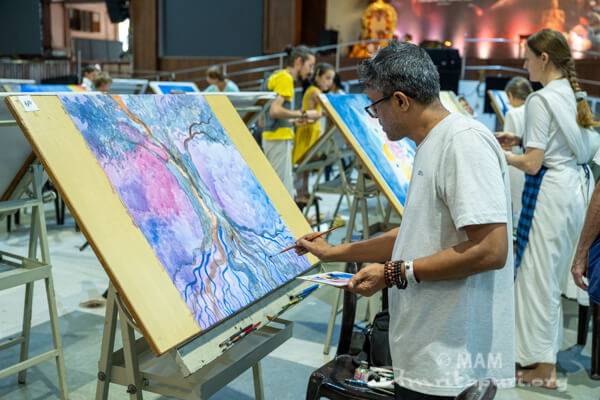
The spiritual canvas of Amritapuri Ashram was woven with the timeless verses of the Bhagavad Gita during the radiant celebration of Gita Jayanthi. Under the theme “Utishtha Bharata—Rise Up, O Bharata,” devotees and artists alike gathered to immerse themselves in the profound teachings of this revered scripture.
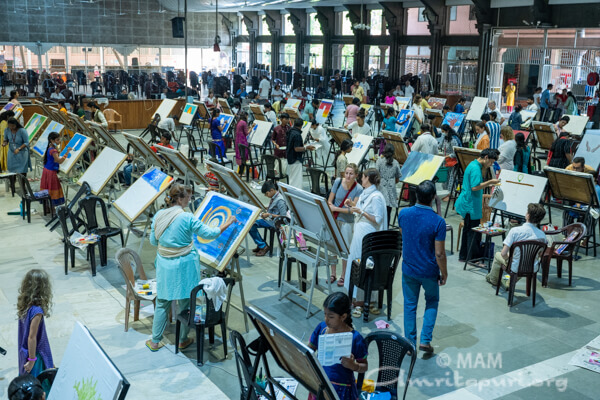
The air was thick with spiritual fervor as participants engaged in a series of events that brought the Gita to life. Gita chanting, Gita talks, and a distinctive Gita painting session were integral elements of the celebration, each contributing to the vibrant tapestry of the day.
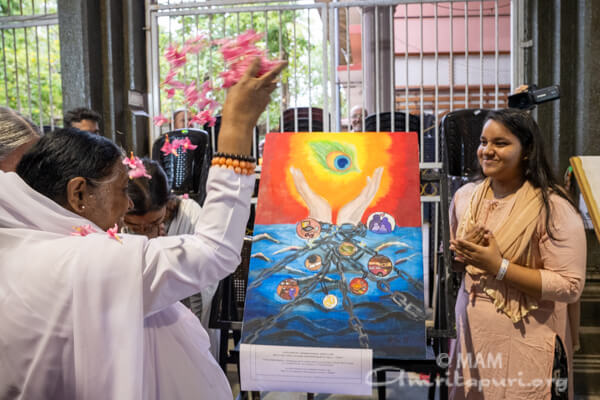
The melodious chanting of all 18 chapters of the Bhagavad Gita by the Brahmacharinis created a divine ambiance, filling the hallowed halls with the essence of spiritual wisdom. Simultaneously, 82 artists, spanning generations and artistic backgrounds, took brush to canvas, transforming the verses of the Gita into a visual symphony of mural, abstract, and character paintings.
The artistic diversity reflected the multifaceted teachings of the Gita, with each artist offering a unique interpretation through their chosen style. Each brushstroke, a silent prayer, collectively formed a tapestry of shared wisdom and devotion, encapsulating the profound teachings of the Gita in a spectrum of colors and forms.
During the evening program, Amma graced the artists, expressing joy and admiration for their creations. Meeting each artist individually, Amma blessed both them and their paintings, creating a moment of profound connection between spirituality and creative expression.
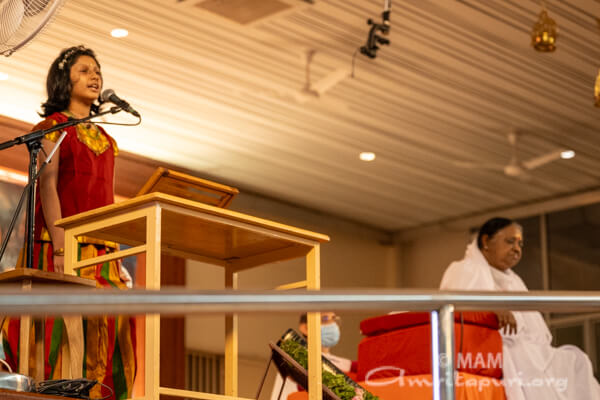
Six Ashram kids took the stage, delivering insightful talks on the Gita in English, Malayalam, and Sanskrit. The speakers and the topics were Sumedha on Brahmisthithi; Anandaraman on Nistraigunyo Bhavaarjuna; Jeevan on Atmanye Atmana Tushtah; Sivaprasad on Yogastha Kuru Karmani; Soham on Raga Dvesham; and Amritavarshini on Fear.
Their reflections delved into the significance of various slokas, practical applications, and how these teachings manifested in their young lives. The children’s eloquence showcased a remarkable assimilation of Gita’s wisdom at a tender age, emphasizing the universal and timeless relevance of its teachings.
Throughout the celebrations, the resonant echoes of “Ponder (Vichara), Practice (Achara), and Propagate (Prachara)” permeated the atmosphere. The event reinforced the enduring impact of the Gita’s teachings on individuals of all ages, fostering a deep connection between spirituality and the expressive canvas of creative minds.
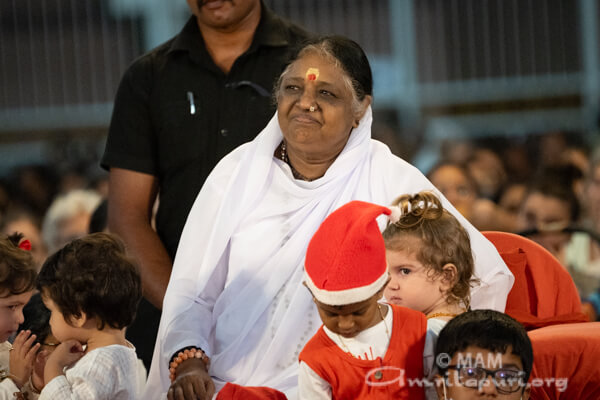
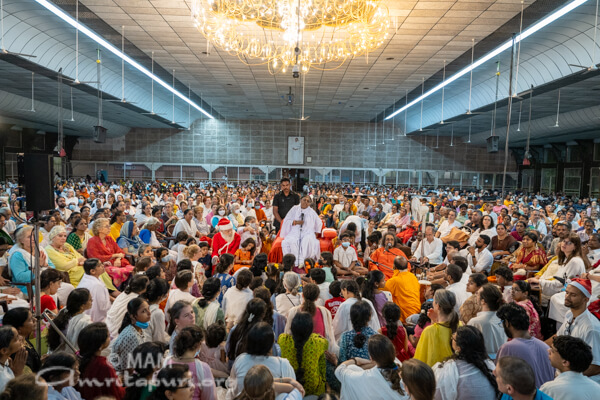
In a joyous convergence of people from across India and around the world, Amritapuri transformed into a melting pot of cultures for its Christmas celebrations. The program unfolded with a diverse array of performances, capturing the spirit of the season.
The festivities commenced with a heartwarming drama featuring a special visit from Santa Claus, who made a delightful stop at Amritapuri on his worldwide journey.
The cultural tapestry unfolded with passionate expressions of devotion through various performances. From a mesmerizing honey bee dance to a Mexican Mariachi singer adorned with a traditional sombrero, Bharat Natyam dancers portraying the vision of Mother Kali, to a Broadway-style dance paying tribute to Amma’s universal love — the stage came alive with vibrant energy.
Amma, the beacon of love, delivered her Christmas message and shared profound insights.
“Mahatmas come into this world like the advent of spring. When spring arrives, all the plants, creepers, and trees put out new shoots and bloom fresh flowers. Dragonflies, butterflies and birds joyfully flit through the air. It feels as though the earth and sky have been revitalised, infused with a renewed and vibrant life. Mahatmas similarly infuse fresh life into human culture. They generate a giant wave of joy, enthusiasm and hope in the human heart. When the full moon shines in the sky, the tide rises on Earth. On a full moon night, we even see the level of the backwaters rise a full three feet higher when compared to the day. The water that is already present in the river rises at that time. This is similar to the joyful swelling of the human heart when our connection to God becomes firmly established. It awakens our inherent potential.”
Reminding us about the importance of Mahatmas, Amma said: “The very presence of the Mahatma reminds us that the primary goal of human life is to attain God-realisation. The potential to do so is present within us but has gone dormant, like a forgotten song. When we hear the first line of that song, its memory is awakened and we are able to recall it. The presence of the Mahatma is such a wakeup call. Their life inspires us to emulate the values they exemplify. Christmas commemorates the advent of Christ on Earth, bearing the message of spirituality to a populace immersed in ignorance. Today the entire world is celebrating this event.”
Amma highlighted the power of viewing the world through the lens of spirituality and serving humanity through the hands of science. She urged humanity to transcend duality and recognize the fundamental essence of all religions — love.
“The one whose legs rush to help the suffering, whose hands yearn to give comfort to the sorrowful, whose eyes shed tears of compassion, whose ears listen to the sorrows of the distressed, and whose words bring solace to those in pain—indeed, they are the true lovers of God!” proclaimed Amma.
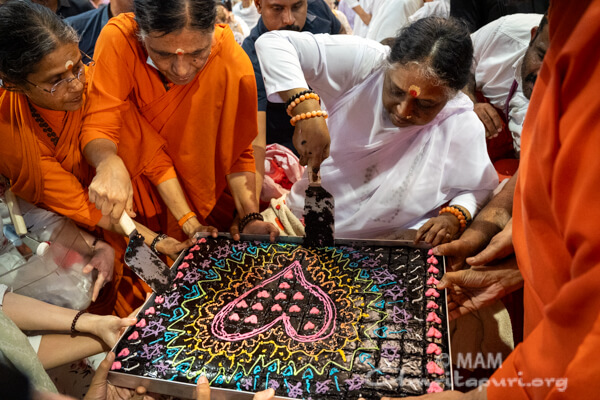
As the celebration unfolded, Amma sang soulful bhajans, and the joyous atmosphere culminated with the distribution of Christmas cake, symbolizing the sweet spirit of unity and celebration.