Blog

  • Gitamritam students presents papers at the International Gita Seminar, Kurukshetra

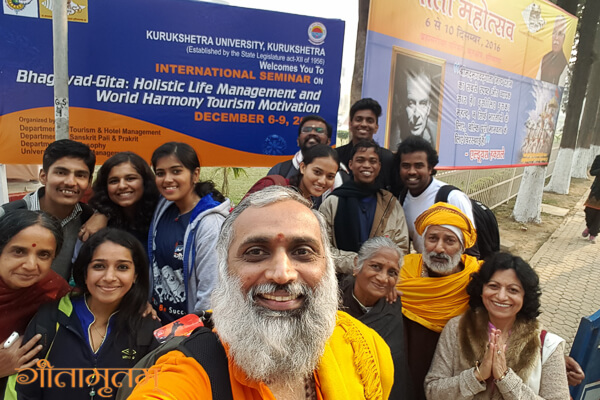
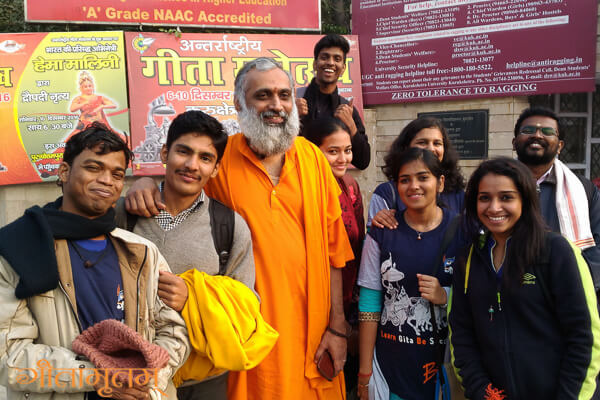
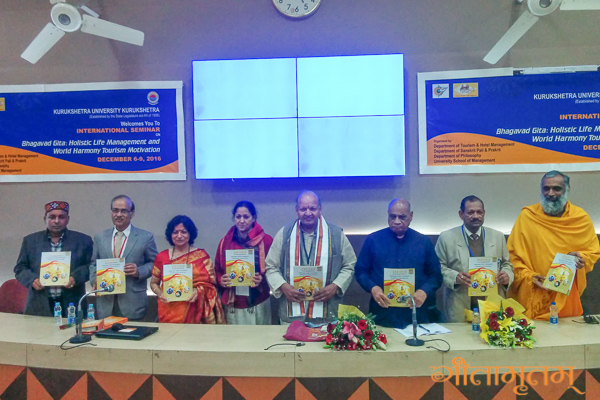
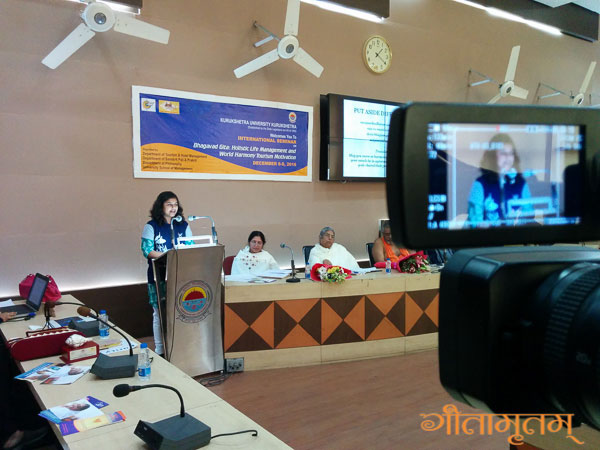
    The Government of Haryana invited graduates of MAM’s Gitamritam Bhagavad Gita Camp to participate in the International Gita Seminar conducted at Kurukshetra University. Kurukshetra is in Haryana, where the Bhagavad Gita was told to Arjuna by Sri Krishna about 5,000 years ago. It is just a 3-hour drive from New Delhi.

    The program was held at Kurukshetra University from 6-10 December at Kurukshetra, Haryana. It was part of the Gita Jayanthi celebrations conducted by the Government from 1st to 11th of Dec.
    seminar-13

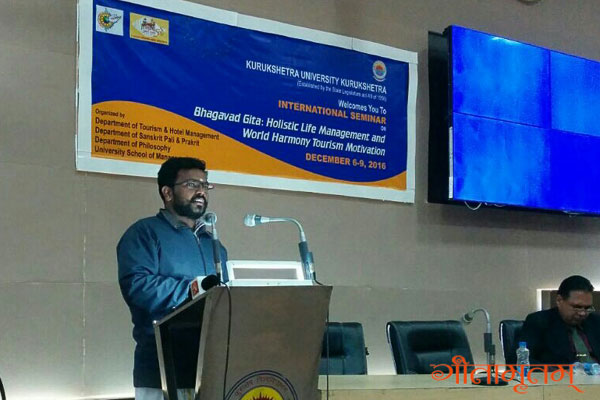
    Nine of the students from Gitamritam were presented papers on various topics related to the Bhagavad Gita at the seminar.

    The topics of papers submitted at the International Seminar on Bhagavad-Gita were:

    1. “Conflict of Choices” by Pro. V Shankar Kumaran, Amrita University, Bengaluru
    2. “Gita in Modern Day Management” by Dhanush BN, Bengaluru
    3. “Ultimate Leadership and Global Village” by Kavin Prasad, Amrita University, Amritapuri
    4. “Gita in Family Dynamics” by Maya Menon, Amrita University, Amritapuri
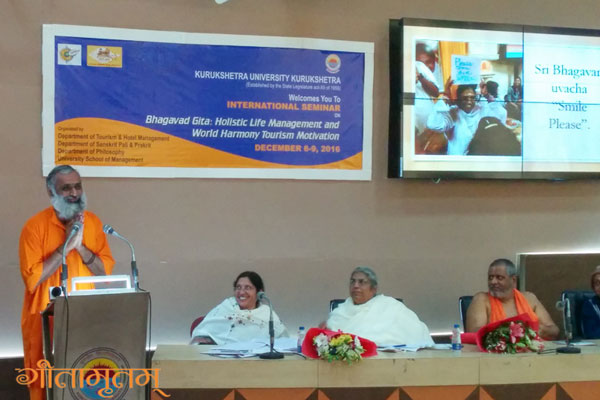
    5. “Sri Bhagavan Uvaca – ‘Smile Please’” by Dhyanamrita Chaitanya, MAM, Amritapuri
    6. “Misconception of Being a Devotee” by Revant Talekar, Karwar
    7. “Dharma Consciousness for Peace & Harmony of the World” by Rishika Rajkumar, Bengaluru
    8. “Fortification of Young Minds” by Namitha PL, Davangere
    9. “Gita for Teens” by Gayathri Devi, Coimbatore

    The last four students are from Gitamritam Camp for Bala – three are in their +1 class.

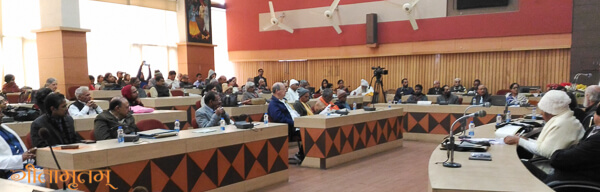
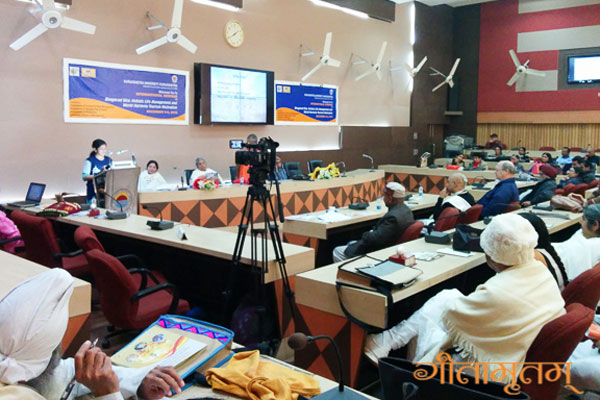
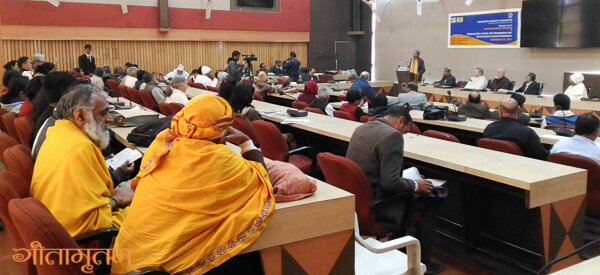
    The panels consisted of Scholars, PhDs, PhD students and even Padmasree awardees. There were more than 250 delegates in the hall, both national and international.
    sankskrit-15

    The delegates expressed great enthusiasm for the presentations given by the young Gitamritam graduates. Several commented, “These kids should have been given more time.” One of the panel chairs invited one of the Gitamritam students to be a part of the panel for next year’s conference.

    Some of the feedback received from the students’ presentations included: “These students have taught in a very special way. Its clear that they have understood the subject,” and “Rather than just repeating what you have heard, you shared original insights.”
    seminar-12

    All the Gitamritam graduates thoroughly enjoyed the experience, gaining at least as much they gave. On the first day of the conference, all the paper presentations were in Sanskrit. After listening to the Sanskrit presentations at the seminar, Rishika (who presented a paper on Dharma consciousness for universal peace and harmony), even though she didn’t understand a single word, was inspired to learn Sanskrit. It was the first time she heard a Sanskrit conversation, and she was overwhelmed by the beauty of it.
    dhyanji-11-2

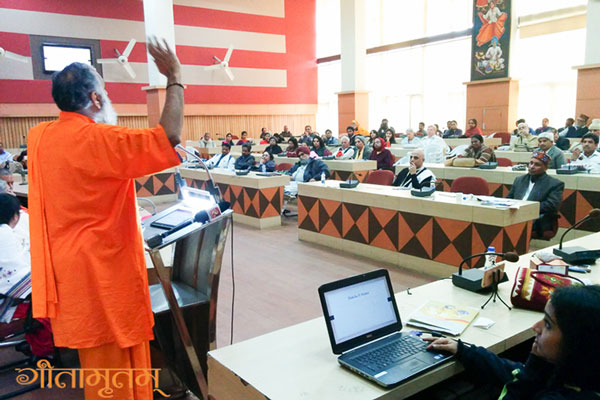
    After a round of speeches by dignitaries gracing the event, Br. Dhyanamrita Chaitanya was invited to share a few words. He spoke about Amma as a Sthitaprajna, and shared his experience of the way Amma lives the Bhagavad Gita in every moment of her life. Suddenly a silence fell over the crowd, many had goosebumps when they learned that that there is a saint who is living the Gita here and now.  “Amma’s disciple’s words had a special power – though each of the scholars who spoke before him was well versed in Sri Krishna’s message as conveyed through the Gita, Dhyanamrita has lived with Sri Krishna himself, embodied in the form of Amma. His experience brought a sweetness and magic to his words that mere theoretical knowledge could never match” said Kavin Prasad, one of the participant of the Seminar.

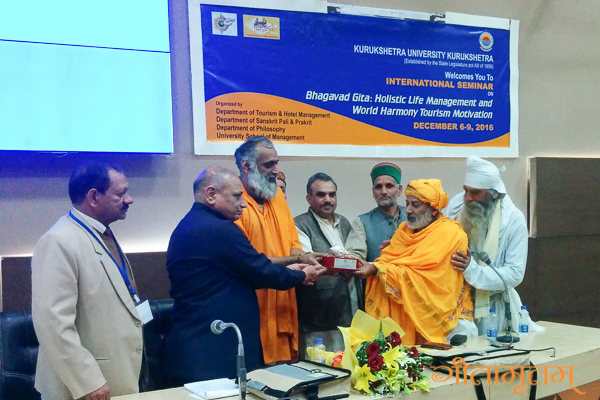
    Following the event, Dr. Misra of Kurukshetra University invited MAM to come and conduct a Gitamritam camp there on campus
    sankskrit-16

    * * * * * * * * * *

    Excerpt of the abstracts of the papers presented:
    gayathri-12

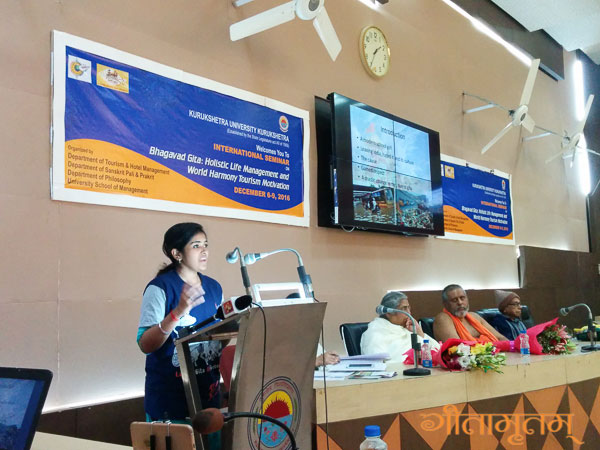
    Gita for Teens – (by Gayatri Devi, 16)
    Thanks to Gita. I have changed from being selfish to being selfless. But at instants, situations ask me to act angry, even though I am not. Gita has taught me, how to overcome anger and how to be detached from this materialistic world, in order to attain God. It has taught me to accept people as they are and that I shouldn’t expect things from others. I even judged people many times, which is a wrong act. The values that I have tried sharing with you through this story, makes not even 10% of what Gita wants to convey. There are loads of things that the instruction manual of being happy coveys to this world. In fact, it is almost as if I am Arjuna, and Gita is Krishna who transforms me.
     

    gayathri-14
    Gita on Family Dynamics – (by Maya Menon)
    Marriage and family are indispensable ingredients of a thriving society. Yet today, many are questioning its relevance and necessity. With the increasing rates of unhappy marriages and dysfunctional families, this paper proposes that the Bhagavad Gita be used as an aid to address and resolve some of the issues our culture today faces. The Gita is the eternal message of spiritual wisdom and has received global recognition on its timeless relevance. With references to various verses from the Gita, the paper explains a few of the many applications of Gita and how it can ameliorate the family dynamics. Simple concepts presented under the light of Gita, such as the art of give and take, seeing divinity in everything, the practice of spiritual values in family life and attachment with detachment are discussed. This paper suggests that marrying the teachings of the Gita into a family life will ensure a life of love, peace and joy.
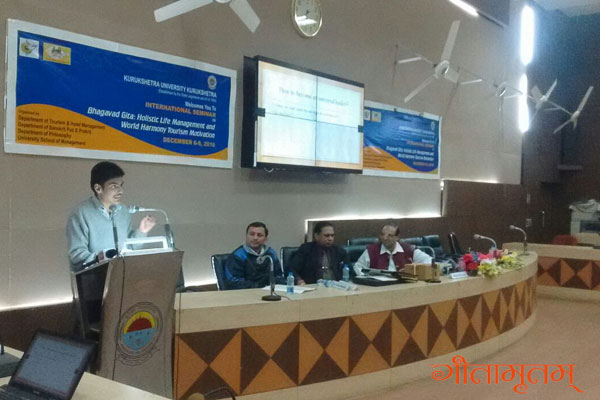
    kavin-11

    Gita the ultimate leadership manual for Global Village (Kavin Prasad & Dipayan Banerjee)
    The real centre is the Universal Centre which is the key to our happiness. A real leader is a person who face the situation and does not run away from the situation. The facing situation will happen only when the person is centred in the Universal Centre. People like Arjuna are intelligent and talented but are not capable to manage the situation when crisis come because such people are deciding based on the Anithya or the Changing. Krishna on the other hand is balanced and still because he decides based on the unchanging or Nithya by seeing the situation for a larger good or good of the universe (Universal Centre). If a person is sheltered in their real nature only then they can be balanced in any situation and only such person can handle any situation may be time management, crisis management, conflict management. The idea of how to remain in the centre, the behaviour of the people who are not in their centre and people in the universal centre is depicted in this article.
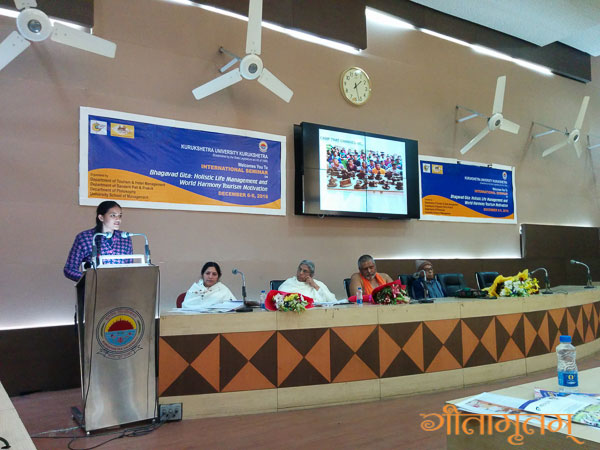
     

    namitha-13

    Fortification of the young minds (by Namitha PL, 16)
    Fortification constructed of self-control and universal love makes the mind impregnable to the foe. A fortified city is free from the danger of being attacked by the enemy. Man’s mind has to be similarly fortified against the invisible enemies. Lust, greed, anger and hatred are the enemies wrecking the career of man. They are capable of invasion at any time. When the mind falls into their hands, man is ruined. It has to be therefore properly fortified. When the defenses are strong the enemy beats a retreat.
    It is by the performance of dharma that the fulfilment of life takes place. The dharma of man is to exert his best for common good. Values of Gita is like a flowing river. It reveals: truth over untruth, justice over injustice, dharma over adharma.
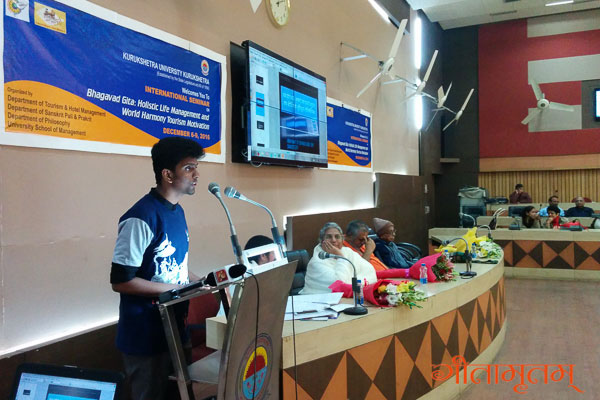
     

    revant-11
    Misconceptions of being a devotee – Revant Talekar
    What makes this conversation that took place ages ago, so relevant to us – people living in 21st century? We often get stuck in similar kind of anguish, in our daily lives. The answer to those predicaments lie in understanding the nature of a devotee which is of paramount significance, rather than just being one. Majority of people would take pride in pledging their devotion and exhibiting it by fulfilling rituals with heart, whole or half.

    It is interesting to see how when asked what should be done, Lord explains what should be strived for, in the twelfth chapter, what he is fond of particularly. It could baffle you since Lord continued to emphasise on importance of attitude than action throughout. My paper shall explore this domain, of nature and misconceptions of devotee – trying to understand what it means to be one.
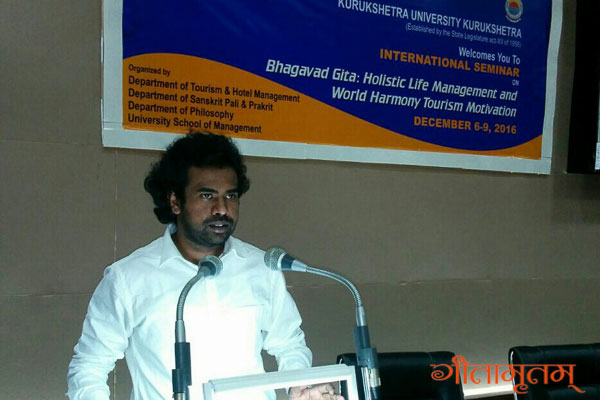
    dhanush-11

    Gita in modern day management – (by Dhanush BN, Bengaluru )

    One of the most critical aspect of management is the self management with respect to one’s schedule, plan and more importantly control of one’s mind. How does Bhagavad Gita offer solutions to such aspects of the modern day management.
     

    rishika-14

    Dharma Consciousness for World Peace and Harmony –  (by Rishika Rajkumar, 16)
    The need for peace and harmony appears to be more of a necessity now than ever before as these problems can only be solved if the world stands together as one and the countries work in cooperation with each other for the benefit of all.
    Why has this not happened yet? The reason for this is that in today’s world, there seem to be many Duryodhanas and Krishnaless Arjunas who are lost and aren’t aware of their dharma. The Duryodhanas include the corrupt politician, the terrorist killing innocent ones, the fraud businessman, the womaniser and down the lane, they also include the seemingly harmless student littering the streets. The Krishnaless Arjunas are the people who sit back in their chairs and comment/critic the actions of the people around them and share their dissatisfaction on social media (with Facebook being the one most commonly used) instead of taking action themselves. All these wrong actions originate from expectations, the feeling of incompletion and the absence of peace in the minds of the people. With Krishna not being there to bring an end to the corruption and guide them down the right path, the Bhagavad Gita is what will help them grow conscious of their duties (dharma) and responsibilities.
     

    shankaran-11

    Conflict of Choices (CoC) – (by V. Shankar Kumaran & Ms. Shambhavi)

    Our each day begins with a conflict, the conflict of choices. Throughout the day we face this conflict. Every moment demands us to choose out of the many options available. And it is that dilemma of doing it or not and doing what which keeps us in whirlpool of confusions. The availability of options ranges from getting up at the first call of alarm or not, choosing coffee or tea to declaring surgical strike against any nation or not as a defence minister, or even the latest decision on demonetization by the Centre. The conflict of choices goes on and on and then there comes a moment to act. And it is that defining moment demanding immediate action which forces us to decide. It is henceforth that particular act of decision making which is actually responsible to give new dimensions to life and to pave new ways for us. The development as we see around us today is nothing but the result of decisions taken long back. The civilized societies and technological advancements are all results of better choices. Similarly, pollution and corruption too are results of the wrong decisions taken by us. These decisions can be changed. If love, compassion, sacrifice, selflessness still exist in this world that too is because of some people’s decision to retain them in this ever changing world.
    dhyanji-11-4

    Sri Bhagavan Uvaca “Smile Please” (by Dhyanamrita Chaitanya)

    All of us were able to smile at everyone out of joy, all around the globe, at the animate and in-animate, with out any differences…when we were all babies. And we loose that blessing as we grow. What have we lost, where have we lost, how we have lost that smile? Bhagavad Gita gives you the key to answer this as learning Gita is to become Krishna himself. Sri Krishna is smiling under any circumstances as he is always aware living in the present. If you want to be happy, be happy right now as happiness is always in the present. Let all your actions not be for happiness and let it come out of happiness. Instead of becoming happy, be happy. Now or never.

    * * * * * * * *
    Download the PDF report of the visit to Kurushetra
    seminar-11


    seminar-14


    Some feedbacks by the delegates of the International Gita Seminar about Gitamritam

    M Chaudhari: It was a new insight, I found the an answer to the question I was searching for.

    S Shulka: Every one was copy pasting from ten books make another one to present here. Yours were original.

    Dinesh: Your style of teaching is very good. Children at this age can speak liked this!!

    P Sharma: These students have taught in a very special way. Its clear that they have understood it.
  • Isn’t learning Gita from book or Internet is enough?

    Isn’t learning Gita from book or Internet is more than enough, given that there are elaborate commentaries and various versions of Gita available?

    If we go by the google search or the dictionary meaning, we would get into trouble. For eg; in Gita, the word “buddhi” is used as intelligence, knowledge and a means of knowledge. Atma is used with reference to body, some other places mind, some other places jiva and in other places as Atma (Self) itself. So we need an Acharya. He can explain what it actually means. An Acharya is important in connecting various parts of Gita and putting it in right perspective. Guru is a must.

    gita-cloth-art

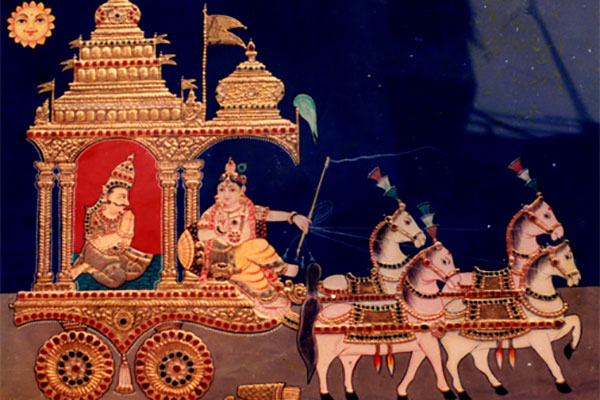
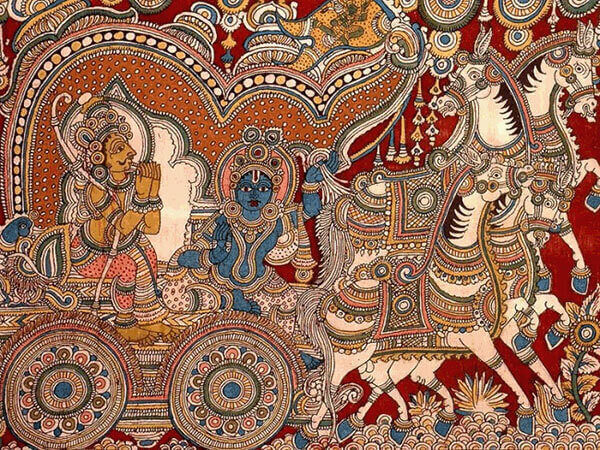
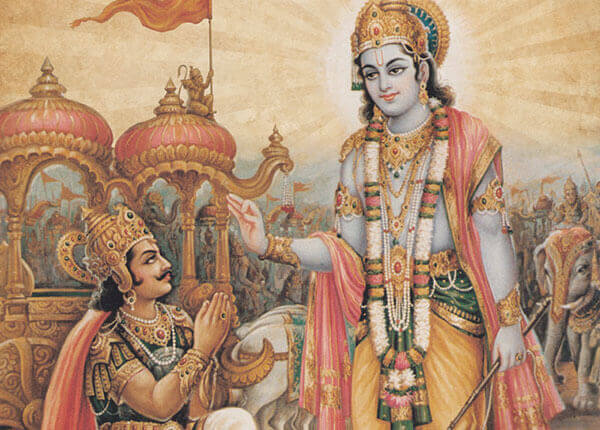
    Arjuna was very cultured and intelligent. He had studied all Dharma Sastras. Sri Krishna was just removing the clouds of his mind so that the sun shine will be visible. Arjuna raises so many questions, Sri Krishna answers all of them. While reading, many of us don’t even understand the question itself; forget about the answer of Sri Krishna. In fact at the end of the chapter Arjuna declares that he is doubt free and will execute his duty efficiently. After studying Gita usually we don’t even come to that level.

    When there are questions about Gita, the Acharya can help us in properly understanding the question. Actually, the Acharya is trying to explain that which can’t be understood by the body, mind or intellect – which is beyond our recognition. There are hundreds of Mahatmas who have experienced this truth – in every century there have been many Mahatmas who have declared this truth to the world.

    A Guru who has seen more than what we could, will be able to correct our vision. A Guru who has seen the truth will be able to do that. With faith in the Acharya, we could try to follow the path shown by him/her. For example, in order to show the moon, the Acharya will point his finger towards the white light at night. The child may not understand what he is pointing to, but the Acharya  will remove all his doubts and take his gaze towards the goal. Similarly, Gita and Sastras are pointers to this truth and we have to go beyond the words by tuning to the Guru. Every Acharya explains in his own style, which is his own freedom, but Gita remains the same. Gita supplies the message to everyone – child, parents, sanyasins or anyone for that matter.

    In the study of Gita, the enquiry should be ignited. When enquiry comes, Guru will be there to guide.

  • Do we pass or get job by learning Gita?

    NO. A job is not assured even after graduating, doing post-graduation and so on. The purpose of learning Gita is not to get a job.  Only if you study you will get marks.  Only if you pass you will be placed on job. In that process even if you fail or you get one or two marks less than you expected, you will not commit suicide if you have the wisdom of Gita.

    gita-win


    The benefit of learning Gita is how to do the job properly and efficiently in a relaxed way. All with a smile. Then success shall be yours.


  • Gita is for the old and dead. Not for us

    sanjaya

    This is another misconception people usually have about Gita. First of all, let us look at whom was Gita told to – Arjuna. Arjuna who wanted to achieve something in life, for which he had been preparing all along his life. Gita was given to him and not for an old person. Gita was given to a person who wanted to achieve something in life and was ready to act for it. So, it is not for the old. Upon learning Gita properly, we will understand that it is extremely useful in our day to day life.

    Gita is not an old Sanskrit text that you need to by-heart and read. It is a set of values, principles and instructions which when followed, one becomes successful in life.

    You may have great dreams and passion in life that you want to achieve. In the process you would have to face many difficulties. People who supported you might turn against you. The friends might turn as enemies. You might lose all your wealth or meet with an accident, even worse lose your  health completely. In life, when these situations arise, how will we pursue your goal? What are the things to keep in mind to still pursue that passion? These are the subjects of discussion in Gita.

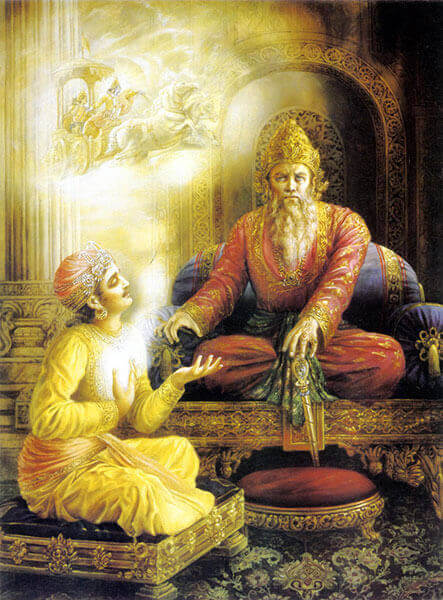
    Old man Drutarashtra also heard Gita, nothing happened to him. His sorrow was not removed. For Arjuna, he could remove the sorrow and ultimately became victorious.

    You argue it’s for the dead? NO way. They cant hear anything, they are dead. It will not help them at all. Gita is for the one who is living, not for the dead.  Spiritual knowledge is only for the living. Whatever you cannot achieve when you are alive, you cannot achieve after your death. Sastras is very clear on that.

    When our breath stops, and desire remains, that is Death….
    When our desires stops  and breath remains, that is Moksha” !!!

  • Why should we learn Gita which is an old textbook?

    Bhagavad Gita  is not a textbook. Even though it is printed and published by Sage Vyasa, it deals with the eternal values one must have in life – certain do’s and don’ts. It is an instruction manual for all human beings. It teaches us how to deal with the objects of the world and people, its nature and limitations.

    geeta-upadesh

    When we buy a new machine, we always get an instruction manual which describes what all it can do, how to operate it, under what conditions it will operate in an effective way, etc. If we do not follow these instructions, it can even damage the machine. Similarly, Gita is the manual for living. Human body and mind are the apparatus given to us. We must know what is mind and what is body and we should also know how to operate them to utilize it in the most effective way to reach the highest in life. Gita teaches us how to live in this world which is filled with challenges and diametrically opposite situations of life like  victory – failure, loss – gain, pain – pleasure, birth – death. In such a situation, how do we live peacefully and lead a happy life? Gita deals with this subject.

    Gita is not old. It’s fresh. By learning Gita, we will be able to handle all the situations of life in a better way. Face and handle them – all with a smile.

  • How to be Happy in life; Gita is the way

    Human beings want to be happy as long as they are alive. Even after death we want to be happy. Gita deals with the subject of what is happiness, how to remain happy even in the midst of challenging situations. Like we use google maps (gps) to reach a destination, if we have Gita Practising System (GPS) we will be able to reach the destination easily. Gita is like a road map of happiness.

    gita-win

    Arjuna was not happy in doing his duty as a warrior. He realised that even if he gets the kingdom without any enemy and without any borders, or even the kingship of heavens, that will not make him happy. Irrespective of the preparations for the war all throughout his life he realises that it is not the goal of his life. That was his question. “How can we be happy killing my own people? (कथम् सुखिनः स्याम माधव ?)  Oh Lord please show me the path to permanent happiness. I seek your help. Please guide me” (यत् निश्चितं श्रेयः स्यात्, तत् मे ब्रूहि । अहं ते शिष्यः । त्वं प्रपन्नं मां शाधि ।).

    Arjuna understood that by his action he was neither happy then nor will he be happy in the future. In the past also the Pandavas had had only sufferings. So how to be happy was his question. Hence Sri Krishna’s answer is in those lines. The answer to finding permanent happiness is the Bhagavad Gita.

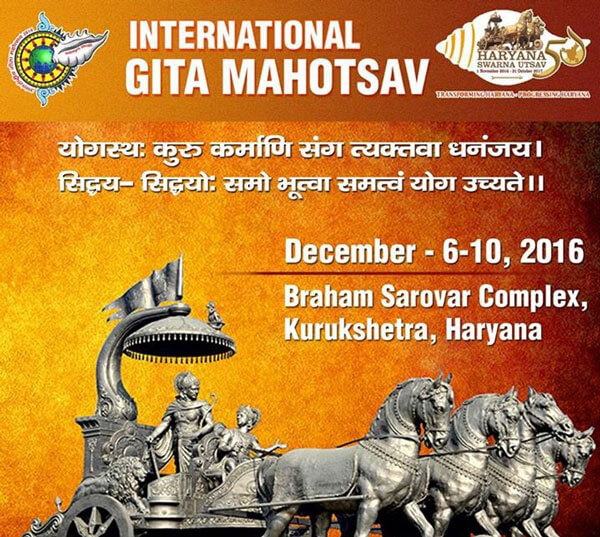
  • Gita Mahotsav at Kurushetra – Gita Jayanthi 2016

    The State Government of Haryana has invited Gitamritam to participate in a Mahotsava being held at Kurushetra in connection with Gita Jayanthi 2016. Eight students of Gitamritam will be presenting papers on various topics at the International Seminar.  Gitamritam also will have a stall, run various Gita games during the occasion.

    yogastha-kurukarma

    gitamahotsav-logo


    A number of cultural performances, art shows, literary events and festivities will mark the celebrations up to December 10th. Indian-American astronaut Sunita Williams and US politician Tulsi Gabbard will also speak at the International Seminar on the relevance of Bhagavad Gita in modern life to be held on the campus of Kurukshetra University.

    18,000 students from all over Haryana will recite the slokas of the Gita at the inaugural function being held at the sacred Brahma Sarovar in Kurukshetra.

    During the event, as many as 574 young men and women, each embodying one sloka spoken by Lord Krishna, will converge at Kurukshetra from different cities across the country.

    Kuruskhetra is in Haryana where Bhagavad Gita was told to Arjuna by Sri Krishna, is 170 KM, just 3.5 hrs away from New Delhi.

  • Profile: Ranjini Menon

    [av_image src=’https://www.gitamritam.com/images/ranjinimenon-1.jpg’ attachment=’7471′ attachment_size=’full’ align=’center’ styling=’circle’ hover=’av-hover-grow’ link=” target=” caption=” font_size=” appearance=” overlay_opacity=’0.4′ overlay_color=’#000000′ overlay_text_color=’#ffffff’ copyright=” animation=’no-animation’ av_uid=’av-jk5ufken’ admin_preview_bg=”][/av_image]

    [av_heading heading=’Ranjini Menon’ tag=’h3′ style=’blockquote classic-quote’ size=” subheading_active=’subheading_below’ subheading_size=’15’ margin=” margin_sync=’true’ padding=’10’ color=” custom_font=” av-medium-font-size-title=” av-small-font-size-title=” av-mini-font-size-title=” av-medium-font-size=” av-small-font-size=” av-mini-font-size=” av_uid=’av-jk7de20r’ admin_preview_bg=”]
    TV Anchor, Writer & Social Activist
    [/av_heading]

    [av_textblock size=” font_color=” color=” av-medium-font-size=” av-small-font-size=” av-mini-font-size=” av_uid=’av-jk5up05j’ admin_preview_bg=”]

    • Jury member for South Indian Filmfare Awards
    • The Executive Member of the Kerala State Children’s Film Society
    • National Vice President of Indo Russian Culture Relations
    • An active member of the Rotary Club and the Junior Chamber
    • Actively involved with Neethi Vedi, an NGO that looks into tribal development
    • The Executive Trustee and Director of Stage Pragathi, a platform for artists and art lovers

    Life

    Ranjini began her creative journey as a columnist and short story writer for various noted women’s magazines and periodicals including reputed broadsheets. She received several awards and accolades at the Kerala State Youth Festival including awards for best short story, painting, poetry.
    Her foray into television began with Akathalam, the first ever Women’s talk show that dealt with women’s issues with great élan and aplomb. Akathalam became the first ever travelling talk show that directly addressed more than 200,000 women across India, which ran for 5 years with 500 episodes.
    As a creative contributor and anchor of the show, Ranjini became the voice of women across languages. It initiated several social discussions in areas such as Mysore Marriages, domestic violence, literacy, and culture etc… which were taken up without any prejudice.

    Some of the high profile shows she has anchored, produced and written in Malayalam are as follows:
    100 episodes – Snehitha on Soorya TV – a women’s visual magazine featuring celebrities
    100 episodes – Penmanassu – on Jeevan TV
    2200 episodes – Shubarathri music show on Jeevan TV
    52 episodes – Parenting on Amrita TV

    She spent two years serving as the CEO of JTPac Kochi, and designed shows involving many celebrities. During her tenure there, she coordinated the biggest show for Kochi City Police called “Aspirations” in addition to the “Kochi Music Festival”. She also directed the 1 Billion Rising – a fight on atrocities against women and included participation from Malayalam playback singers and other personalities from Bollywood and cricket.

    Education

    Degree in Economics from the Union Christian College
    MA in Developmental Economics from Pondicherry Central University
    MA Psychology from Annamalai University
    Specialization in Child Psychology and B.Ed in English and Social Sciences – all with distinction.
    She carried out her entire studies under National Merit Scholarships.

    Family

    Lives in Wayanad with her family. Ranjini is married to Rajagopal Menon and is blessed with two children, Aditya and Malavika. Malavika is an artist, dancer and writer who has published her own works.

    Gitamritam speaker in the year 2016.
    [/av_textblock]

  • Profile: Karma Yogi Ravi Kalra

    [av_image src=’https://www.gitamritam.com/images/ravikalra.jpg’ attachment=’7468′ attachment_size=’full’ align=’center’ styling=’circle’ hover=’av-hover-grow’ link=” target=” caption=” font_size=” appearance=” overlay_opacity=’0.4′ overlay_color=’#000000′ overlay_text_color=’#ffffff’ copyright=” animation=’no-animation’ av_uid=’av-jk5ufken’ admin_preview_bg=”][/av_image]

    [av_heading heading=’Karma Yogi Ravi Kalra’ tag=’h3′ style=’blockquote classic-quote’ size=” subheading_active=’subheading_below’ subheading_size=’15’ margin=” margin_sync=’true’ padding=’10’ color=” custom_font=” av-medium-font-size-title=” av-small-font-size-title=” av-mini-font-size-title=” av-medium-font-size=” av-small-font-size=” av-mini-font-size=” av_uid=’av-jk7dacvc’ admin_preview_bg=”]
    Founder and President of The Earth Saviours Foundation
    [/av_heading]

    [av_textblock size=” font_color=” color=” av-medium-font-size=” av-small-font-size=” av-mini-font-size=” av_uid=’av-jk5up05j’ admin_preview_bg=”]
    Since 2008 he has been fully dedicated to improving the lives of destitute children, abandoned senior citizens, victimized women and mentally disabled people. Every day, the Foundation feeds hundreds of people and works to preserve and renew the beauty and goodness of our planet Earth. He has also overseen the proper cremation rites for over 5000 unclaimed bodies.

    Founder of

      The Earth Saviours Foundation
      Charitable old age home
      Rescue centre for mentally disabled people
      Jia Nari Niketan (a shelter for deprived females)
      Goshala (shelter for stray cows)
      Indian Amateur Taekwondo Federation

    As President of  Indian Amateur Taekwondo Federation he has taught the national teams of various countries. He has achieved IVth Dan Black Belt and received the degree of International Master – Instructor in Taekwondo Martial Arts. He had also taught unarmed combat to school children and soldiers posted in different battalions.

    Environmental protection

    He is the first man to start “Do Not Honk” campaign to educate drivers not to honk unnecessarily while driving  in an effort to control noise pollution. He is a world record holder by wiping out “Horn Please” signs from the back of over one lakh commercial vehicles. For this he is known as the “No Honking Man of India”.

    He is battling to save forests in India by filing PIL (Public Interest Litigation) in Supreme Court of India.

    Priest

    There are people who die during road/train accidents or who are found floating in the Yamuna River, or half eaten by animals or who have died in hospitals or accidents. These unidentified and unclaimed bodies are brought by the Police authorities to the cremation centre, where Ravi Kalra offers his helping hand to perform a proper cremation with prayers and dignity. So far he has cremated more than 5000 bodies.

    Awards

    Sardar Vallabhbhai Patel International Award for Excellence in Selfless Humanitarian Services.

    Serving 24/7

    Ravi Kalra feeds hundreds of poor people everyday. He works tirelessly 7 days in a week. He has devoted his life to look after poor, deprived, abandoned and disabled people.

    He was the President of Rotary Club of Delhi Ridge for the year 2013-2014, and has also traveled to 47 different countries around the world.

    Serve even after death

    He has pledged to donate his eyes, kidneys, heart valves and other useful organs after death for needy people. He has also pledged to donate rest of his body for medical research.

    Gitamritam speaker in the year 2016.
    [/av_textblock]

  • Profile: Dr Velivela Satya Prasad

    [av_image src=’https://www.gitamritam.com/images/satyaprasad-1.jpg’ attachment=’7465′ attachment_size=’full’ align=’center’ styling=’circle’ hover=’av-hover-grow’ link=” target=” caption=” font_size=” appearance=” overlay_opacity=’0.4′ overlay_color=’#000000′ overlay_text_color=’#ffffff’ copyright=” animation=’no-animation’ av_uid=’av-jk5ufken’ admin_preview_bg=”][/av_image]

    [av_heading heading=’Dr Velivela Satya Prasad’ tag=’h3′ style=’blockquote classic-quote’ size=” subheading_active=’subheading_below’ subheading_size=’15’ margin=” margin_sync=’true’ padding=’10’ color=” custom_font=” av-medium-font-size-title=” av-small-font-size-title=” av-mini-font-size-title=” av-medium-font-size=” av-small-font-size=” av-mini-font-size=” av_uid=’av-jk7d765d’ admin_preview_bg=”]
    Cadio Vasuclar Surgeon
    [/av_heading]

    [av_textblock size=” font_color=” color=” av-medium-font-size=” av-small-font-size=” av-mini-font-size=” av_uid=’av-jk5up05j’ admin_preview_bg=”]
    Consultant in Adult Cardio Thoracic and Vascular Surgery. Assisted and performed over 20,000 cardiovascular procedures. Pioneered the Trans Myocardial Revascularisation programme. Performed the first human cardiac transplantation in the country. Innovated a novel technique of open-heart surgery on beating heart.

    Education

    Born in May, 1953, he took MBBS from Govt. Stanley Medical College, Madras(1978, University of Madras) and SM (Cardiovascular Surgery) from Tashkent State Institute of Medical Sciences, USSR in 1985.

    Work Experience

    Dr Satyaprasad started working in India as Senior Resident at the Institute of Cardiovascular Diseases at Madras Medical Mission in 1990 and later started working at Amrita Institute of Medical Sciences, Kochi. He is currently at Sevenhills Hospital in Mumbai.  He has assisted and performed over 20,000 cardiovascular procedures abroad and at home till date.

    He is involved in fellowship training in cardiac surgery for students from various East African Countries, as well as Bangladesh and India.

    Innovation

    Pioneered the TMR (Trans Myocardial Revascularisation) programme, performed the first human cardiac transplantation in the country, and has performed over 250 TMR procedures.

    He innovated Mitral Valve Repair Procedures, a technique of open-heart surgery on beating heart .

    Papers and presentations

    Attended 24 conferences and seminars in various countries which including Canada, Germany, UK, Brazil, USA, Greece, Thailand, Moscow and India.
    He has published articles in 12 journals and presented three scientific papers at national and international levels.

    Awards

    He has received six fellowships awards from India and abroad which including Excellent Cardiovascular Surgeon of the Year 2011-2012 award.

    Gitamritam speaker in the year 2016.
    [/av_textblock]