Blog

  • Do you have sorrow? If so, you need Gita

    13. Gita is a religious textbook, just like Bible is for Christianity and Quran for Islam. So, why should I, being a non-Hindu even read it?

    geeta-updesh

    Gita is not just a religious textbook. It is a manual on how to live life happily. Just like we get manual when we buy a device, Gita is the manual for human beings. For an electronic device, unless we follow the manual it might get burnt or get damaged. For maximum output and best result one must follow the manual. Similarly, we have to follow these instructions of Gita to lead a happy life. Whether God exists or not is not the question. Do you have sorrow? If so, you need this. Gita is teaching us how to get rid of the sorrow permanently. In LIfe any situations can arise at any time. All that we have valued all throughout life could leave us, we may fail in exams, we will falter in life, or fall sick and our businesses may fail in a moment. When we understand this, we will be prepared and be unaffected by it.

    Other texts are applicable to certain section of society, age group, race, gender, space and certain time etc. But Gita is applicable irrespective of time and space. Gita is incomparable with any other books – it is not a religious text, but a Universal manual on how to live a happy life.

  • Can one be an atheist and still benefit from the Gita’s message?

    Yes. it is only sufficient to believe in oneself.

    The word “atheist” is generally used to say that you don’t believe in God. But what is the idea of God in your mind? Where is he? Is he there in temple? is He is the stone? Or is he residing high up in the clouds? God is He or She or Both or None? People are not clear about the idea of God. Even the so-called believers don’t have right understanding about God. It is interesting to note that even atheists are considered and given a representation in Vedas (referred to as Charavakas).

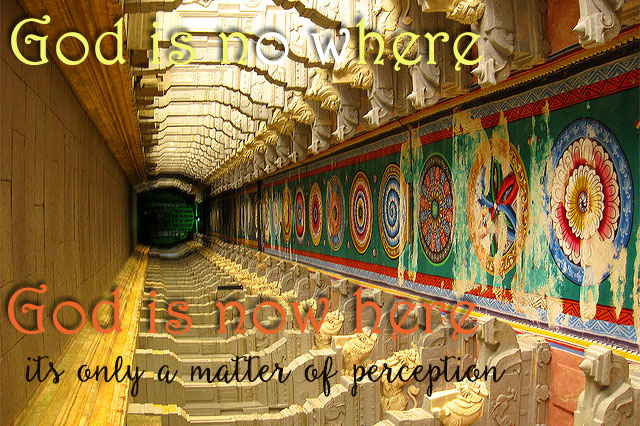
    rameswaram

    Bhagavad Gita is not talking about God in temple or resides in heaven. Gita specifies that God is inside you and me and the purpose is to realize this God, the very nature of our Self, which is nothing but pure consciousness and happiness. Sanatana Dharma propounds this truth. That same God lives in everyone, you and me. It is not separate from you. Believe or not, without him we can’t even disbelieve him. So, it is only sufficient to believe in oneself.

  • Meaning of Saha Navavatu – English meaning and Sanskrit lyrics, Indian concept of education

    What is the meaning of the Shanti Manta: Sahanavavtu ? Can you explain the meaning and its applications?

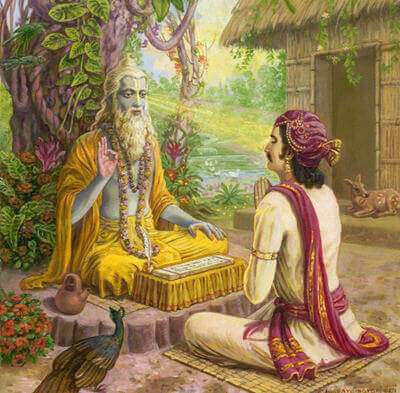
    guru-shishya


    सह नाववतु। सह नौ भुनक्तु।
    सह वीर्यं करवावहै।
    तेजस्वि नावधीतमस्तु
    मा विद्विषावहै।
    ॐ शान्तिः शान्तिः शान्तिः ॥

    Om Saha NaAvavatu | Saha Nau Bhunaktu |
    Saha Veeryam Karavaavahai |
    Tejasvi NaAvadheetam-Astu
    Maa Vidvishaavahai |
    Om Shaanti: Shaanti: Shaanti: ||

    अन्वय:- ॐ सह नौ अवतु | सह नौ भुनक्तु। वीर्यं सह करवावहै। नौ अधीतम् तेजस्वि अस्तु | मा विद्विषावहै ||

    Meaning:
    Om=Supreme Lord;
    avatu=may the Lord protect, nau=both of us; saha=together;
    bhunaktu= may the Lord nourish; nau=both of us; saha=together;
    karavāvahai= let both of us perform; vīryam= valorous actions; saha=together;
    adhitam= learning; nau= of both of us; astu= may be; tejaswi = bright;
    vidvishavahai=let both of us hate each other; mā= not;
    Om Shanthi:= peace Shanthi:= peace Shanthi:= peace

    Om, May the lord protect us both (the Teacher and the Student); May the Lord nourish us both; Let both of us perform valorous actions together; The learning of both of us may be bright; Let us not hate each other. Om, Peace, Peace, Peace.

  • Why was a battlefield chosen as the stage for giving this message?

    Q: Why was a battlefield chosen as the stage for giving this message? Why not, say a classroom, or a quiet serene place which will be more conducive for teaching?

    This is the greatness of Veda Vyasa Maharshi.

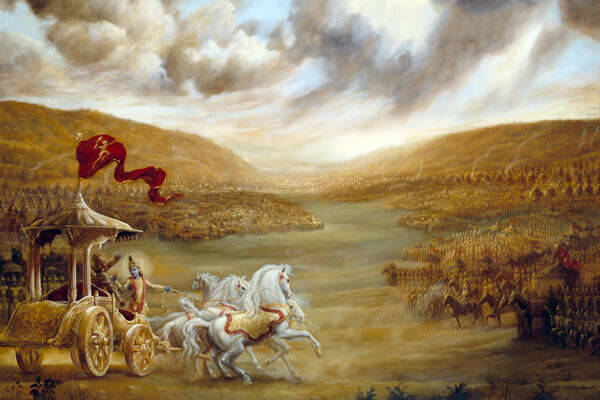
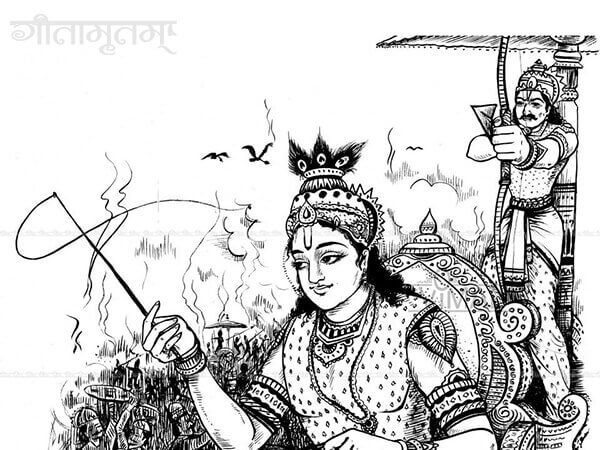
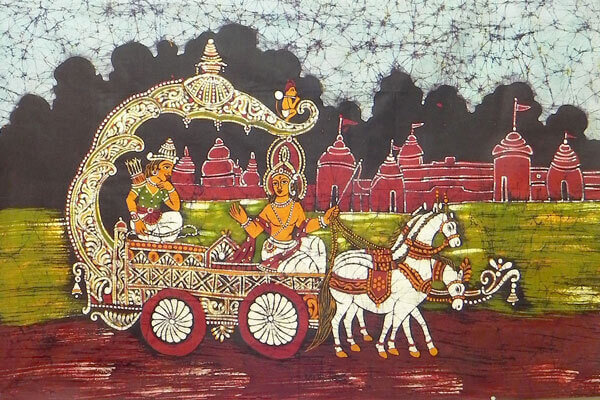
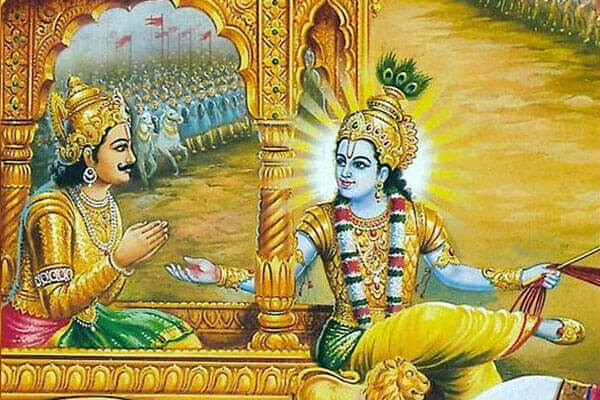
    The generally prevalent idea is that spirituality is a matter to be thought of during retired life in a secluded forest, in an environment of complete silence. But it is not so and way beyond that. In order to live life dynamically and achieve the highest success in life, Spiritual understanding is essential. So in order to drive this idea Vyasa beautifully portrays the story of Mahabharata and in the middle of the battle field where is full of tension, fear, hatred, anger, uncertainty and noisy situation. Arjuna is confused, depressed and dejected. Sri Krishna is giving the message and inspired Arjuna to act enthusiastically. That message is Gita. One need to understand this. This is what spirituality is all about – keeping the mind balanced, face all challenges of life with a smile. Only when the mind is calm and quiet you can take the right decision. Some of the most difficult places to practice the lessons of spirituality are when we are in difficult situations, such as a war, busy market place, exam hall etc. It is difficult to practice our dharma with complete happiness even in these situations.


    gita-updesha2

    In the war, Arjuna was only a representative of mankind. When we face such difficult circumstances, we become like Arjuna. For e.g., we have prepared for final exam sacrificing everything. Upon hearing the 1st bell, you instantly start to get fear, followed by shivering and sweating. And upon receiving the question paper, your pen slips away from your hand, you see bad omens, lips are dry and sticking together, feeling thirsty, darkness covers your vision and getting dizzy. We starts thinking why should i write this exam? I dont have the ability to win this,  caught up in fear, anxiety or excitement. We are thrown, helplessly into the Arjuna Mind condition, i.e., “vishada” a state of depression!! Then a Bhagavan is needed to give Gita teaching us how to handle body and mind, focus on the goal correctly and tune mind properly to solve the problem at hand. In fact, everyone goes through Arjuna state of mind (i.e., the 1st chapter Vishada yoga, the Yoga of Depression! ). We can observe that many educated people get depressed due to various reasons. When expectations break, lose girlfriend, a friend gets better marks or job, wife earns more and innumerable reasons. But the problem is we never get to the 2nd chapter – Samkhya Yoga – the leaning or knowledge from life’s experiences. So we need a Guru, guide and friend who can help us to take us to the 2nd chapter of life.

    We can even say that Arjuna represents the modern youth. We are endowed with everything, but fail to live up to the situation. We want to do good, but fail to do so.

    Even in the sorrow, there is a chance of new life. Gita teaches us how to effectively use our sorrow to rise and go ahead with our dharma.

  • Sri Krishna bended the rules of war to defeat the enemy?

    Q: There are many occasions when Krishna advocates for bending the rules of war to defeat the enemy? Should he not practice what he preaches?

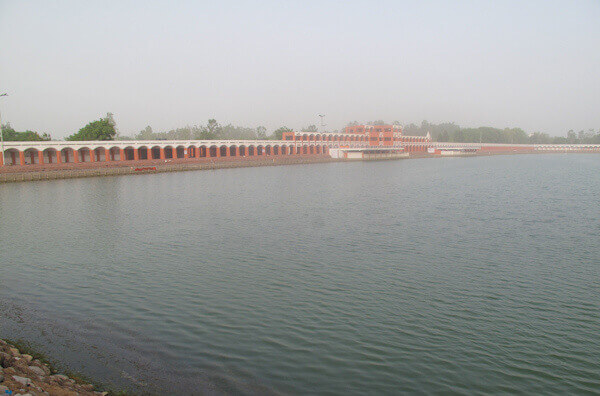
    About the rules of the war, in the olden times the rules of the war were well defined. Some of the rules were that war cannot be continued after the sunset, a person should not to be attacked if he is on a chariot or unarmed. In the evening all of them used to take bath in the same lake!. The lake is still there in Kurushetra. Its called Brahmasaraovar.

    sarovar

    Kauravas broke the law first in case of Abhimanyu. 16 people attacked and killed him from behind, while he was unarmed. From the 4th day onwards, war was no more dharmically fought. As such when one party breaks the rules of the war, the other party will be forced to do the same.

    Some of the last verses in Mahabharata asks the question: “Why are you not following dharma? You can enjoy artha and kama through a life based on dharma.”

  • Krishna was not a Sannyasi then how is he qualified to give spiritual advice?

    Q: Krishna was not a Sannyasi or a brahmachari, then how is he qualified to give spiritual advice?

    It is interesting that the householder Krishna advises a householder Arjuna on how to lead a life towards real Sannyasa. Sannyas is not running away from life, but living your life fully dedicated to the society in a spirit of detachment.Live with complete happiness in spite of all obstacles you may have to face in life is real Sannyas. Krishna lived a life that was embodiment of what he preached.

    krishna-teach

    When we take the examples from Sri Krishna’s life, we can see that he had to face multitude of hurdles even in his childhood. Six of his siblings were thrashed to death by his own uncle. Sri Krishna was born in the jail and was attacked by demons many times. But even during all these, he lived fully established in happiness. Not allowing any of these external circumstances and hurdles to affect his equipoise. Finally, towards the end of the Mahabharata, his whole family fought and killed each other. Even while leaving his mortal frame, Sri Krishna had a smile and was completely happy. Therefore, his life is a perfect role-play of the greatest ideals that he had preached.

  • Does the Bhagavad Gita advocate for war?

    The war described in Mahabharata was fought in righteousness.
    The rightful kingdom of Pandavas were denied to them by Kauravas. They asked for half of the kingdom, but denied. Then they asked for 5 villages, then reduced the demand to 5 house in that kingdom. But even that was denied by Kauravas. Before the war, Sri Krishna went to the Kauravas as peace messenger, but Duryodhana was not willing to accept even the smallest of their demands. Duryodhana said they will not even give an inch of land to Pandavas.

    gita-updesha

    Apart from these, the Mahabharata war was in the making for a long time than this. War started when even when they were young, Bhima was attacked. The enmity was long standing.

    A point to note is that king Dritarashtra was partial and did not correct his children when they were involved in adharma. Instead his attachment to his sons overpowered his discriminative power.

    Finally, there was no option other than war.

    When the war started, Arjuna, upon seeing relatives, he is unable to perform his duty as a warrior. Arjuna was respected and feared by enemies too. They had very high respect for his abilities as a warriors. But, though Arjuna, as a warrior was supposed to fight for dharma, he was not able to do so.

    A nice way to understand this is through a simple example. He came to fight (his dharma), but didn’t want to fight seeing his relatives and he wanted to take sanyasa (which was not his dharma). Sri Krishna cleared the confusion and asked to do his duty. Since Arjuna was a warrior and his duty was to fight against adharma, he fought the war.

    This is equally applicable to any other profession and person too. We many a times prepare to do our dharma, but seeing the enormity of task or the hurdles we try to run away from them to take up someone else’s dharma. This is the confusion that Sri Krishna clears through Bhagvad Gita.

    Gita is not talking about war. Interestingly, never in the history has anyone gone for war after reading Bhagvad Gita, rather it has inspired millions to stick to a life based on dharma.

  • Prasad Deole


    Mr. Prasad Deole, an adventure tourism entrepreneur had an exhilarating account of a journey of success. Back in 1998, it was an outright irrational idea to invest in an adventure sports and outbound training center as no one in India had tried such a task earlier. Definitely, it was a venture full of risk and uncertainty but Mr. Deole and his partner went ahead with their vision and established Z Bac Adventures Pvt. ltd. the next year at Kolad, Maharashtra. The whole project materialized from an idea of a personality development program for children through adventure sports.

    It was a herculean task to convince school PT teams and corporate HR departments to come out of their comfort zones and enter an outdoor arena. But, once the word spread about the unique location and experience, people began flocking to Z Bac Adventures, making it India’s first adventure resort. Eventually, it achieved an ISO certification and redefined the concept of corporate training and adventure holidays in India.

  • Profile: Dr R Ganesh, Carnatic Muscian

    [av_image src=’https://www.gitamritam.com/images/ganesh.jpg’ attachment=’7462′ attachment_size=’full’ align=’center’ styling=’circle’ hover=’av-hover-grow’ link=” target=” caption=” font_size=” appearance=” overlay_opacity=’0.4′ overlay_color=’#000000′ overlay_text_color=’#ffffff’ copyright=” animation=’no-animation’ av_uid=’av-jk5ufken’ admin_preview_bg=”][/av_image]

    [av_heading heading=’Dr. R Ganesh’ tag=’h3′ style=’blockquote classic-quote’ size=” subheading_active=’subheading_below’ subheading_size=’15’ margin=” margin_sync=’true’ padding=’10’ color=” custom_font=” av-medium-font-size-title=” av-small-font-size-title=” av-mini-font-size-title=” av-medium-font-size=” av-small-font-size=” av-mini-font-size=” av_uid=’av-jk7d3si5′ admin_preview_bg=”]
    Carnatic Muscian
    [/av_heading]

    [av_textblock size=” font_color=” color=” av-medium-font-size=” av-small-font-size=” av-mini-font-size=” av_uid=’av-jk5up05j’ admin_preview_bg=”]
    In spite of being a university rank holder in Veterinary Science, chose to follow his passion of Carnatic music and made that into his profession.

    Belongs to the family lineage of Great Composers Shri Kavikunjara Bharathigal and Shri Koteeswara Iyer, who was the first to compose krithis in all the 72 Mela-kartha ragas and the lineage which could be traced back to the famous Saint Thyagaraja!

    He was not pressured at home to follow music but the conditions were made conducive and the interest in music was kindled by his father during his childhood. Ganesh started his training in vocal carnatic music at the age of 10 who was born in 1968.

    Inspired by the songs of Sri Maharajapuram Sandhanam, he made it his life’s goal to learn music only from him. Had “Gurukulavasa” system of training from the Great Maestro for six years.

    Has started giving individual music concerts throughout India after 1992 and has been performing in leading music institutions in India and abroad. He is a regular performer and an “A” grade artist in All India Radio and Doordarshan .

    Dr Ganesh has given exclusive concerts based on themes – kritis of a particular composer. For the International Conference of Siva Bhakthas he rendered “Om Namasivaya” in 108 ragas named Siva Haaram.

    Awards

    Since 1998 he has been confered upon with various prestigious awards like The Maharajapuram Memorial Prize, G.R.Chari Memorial Prize, Shri Nataraja Iyer Memorial Award, Sangitha Chinthamani, Yuva Kala Bharathi, Gnana Sangeetha Mani, Isai Arasar, the Youth Excellence award , Asthana Vidwan, Sri Veda Vyasa Kala Seva Ratna, Chennaionline – Isai Vendar, Isai Peroli, Vijaya Vitthala Prashasti, Sangeetha Seva Ratna, Nadha Chinthamani, Sangeethacharya Bhushan, Sangeetha Kalabharathi and Sangeetha Mummoorthigal Seva Bhushan.

    Eight audio album also were released by leading gramophone companies in his name.

    Social Service

    Irai Isai Payanam is an innovative method which the artistes do not receive any remuneration and the entire proceeds of the concert go for noble causes like renovation of old temples which are uncared for. He has collected nearly Rs.25 lakhs out of 60 concerts so far for various temples renovations.

    Gitamritam speaker in the year 2015.
    [/av_textblock]
  • Profile: Dr. PS Udayan

    [av_image src=’https://www.gitamritam.com/images/ps-udayan.jpg’ attachment=’7459′ attachment_size=’full’ align=’center’ styling=’circle’ hover=’av-hover-grow’ link=” target=” caption=” font_size=” appearance=” overlay_opacity=’0.4′ overlay_color=’#000000′ overlay_text_color=’#ffffff’ copyright=” animation=’no-animation’ av_uid=’av-jk5ufken’ admin_preview_bg=”][/av_image]

    [av_heading heading=’Dr. P S Udayan’ tag=’h3′ style=’blockquote classic-quote’ size=” subheading_active=’subheading_below’ subheading_size=’15’ margin=” margin_sync=’true’ padding=’10’ color=” custom_font=” av-medium-font-size-title=” av-small-font-size-title=” av-mini-font-size-title=” av-medium-font-size=” av-small-font-size=” av-mini-font-size=” av_uid=’av-jk7d0fr5′ admin_preview_bg=”]
    Professor in Botany of Sri Krishna college, Guruvayur
    [/av_heading]

    [av_textblock size=” font_color=” color=” av-medium-font-size=” av-small-font-size=” av-mini-font-size=” av_uid=’av-jk5up05j’ admin_preview_bg=”]
    Had the distinction of having discovered 25 plants from the Western Ghats and out of which two plants have been named after him.

    Besides having worked in the Government, he spent nearly 22 years on research.  He has also worked as a Scientist in Kottakal Arya Vaidya Shala and published several journals, papers and books on the plants and medicinal plants.

    Gitamritam speaker in the year 2015.
    [/av_textblock]